Douglas Imbrogno is an exceptionally creative man, someone who can tell a story both in words and in pictures.
His essay here tells of a pivotal dynamic in his childhood, and of the night his emerging adult identity intersected his parents’ stormy marriage.
Something has broken in me. I quiver head to toe, shaking uncontrollably for minutes. I do not to this day have the words to describe what broke, unless it was something like the compact between parent and child. It had something to do with the fact that never again could I look at my parents without complicity, a knowing and direct participation — both embarrassing and far too personal – in the magnitude of their estrangement.
Please watch the first 25 seconds of this video, http://www.youtube.com/watch?v=3Ta3jFvl3gU, and then take some time to read Doug’s essay. He does here so well what I believe many writers want to do: Engage, tell, and reflect without expecting to understand or catalog.
Sometimes the telling is enough.
Happy Again | by Douglas Imbrogno
Tommy Helms ranges into the pocket at second base. He dives, nabs the ball then pops onto his knees, scooping it to Darrell Chaney. The shortstop foot-taps second base then whipcracks the ball to first base, inches above the head of an onrushing Dodger. A picture-perfect double play. The Dodgers are done for and the win at Dodger Stadium vaults the Cincinnati Reds back into first place in the National League West.
Then, several things happen at once.
In the time it takes radio waves to travel 2,400 miles across the better part of America, a triumphant fist punches upward from beneath a blanket decorated with trains in a Cincinnati bedroom. My 13-year-old fist. The punch upsets the applecart of my bed in the musty basement bedroom of our house at 707 Waycross Road. My G.E. transistor radio tumbles onto the floor. It is past 1:30 a.m. on a school night and I should be sleeping, but true-blue adolescent Reds fans sneer at the three-hour time difference between here and L.A. The radio crackles to life down on the blue throw rug beside the bed: “And this,” says Reds announcer Joe Nuxhall, signing off with a signature line that recalls his own pitching days, “is the old left-hander, rounding third and heading for home.”
Thump! Upstairs a door slams open. Light footsteps can be heard tramping downward from the third floor, then again, down a short flight to the family room above my head. Moments later, heavier footfalls trod the same path. My mother. With my father following. “Leave me alone!” I hear, muffled through the ceiling. My mother. “What! What is it?” I hear my dad say, in a furious strangled whisper. I grab the radio off the floor, retreat back into the cove of my covers.
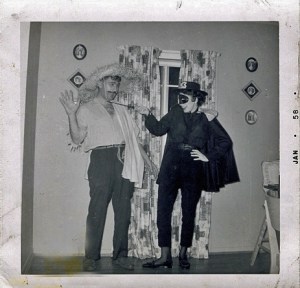
The author's dueling parents in better days from a photo taken eight months after he was born.
“You think sex is something …” I don’t hear what he says after that. I don’t want to hear. Please, I really don’t. But the house is made of plywood and plaster. It rests in one of the fast-built subdivisions north of the city, at the edge of the country where the cornfields start. There’s not much you don’t hear when someone shouts the next floor up. Or cries. No, my mother isn’t crying. She’s weeping. I doubt I knew the distinction back then, though now I do.
Through my basement window, which I keep open on all but the coldest nights, I can hear cows lowing on quiet nights as their exclamations carry from the hilltop farm a mile away. I hear overnight trains hoot-hooting through the valley on their way somewhere else. On nights like these, which are all too common, I dream I might hop a train like the hobos do.
Be gone.
Far gone.
This time, the shouting, the weeping, it just won’t stop. Fierce words from my father. He doesn’t hit her, I know that. He never has. He never will, though I hardly know that this night. Nor has he ever hit us, the six of us kids. We will later come to know how his own Italian father beat on him and his brother. Finally, my dad escaped, decamping to the Merchant Marines, floating off at age 17, across the waves of Lake Erie and Lake Superior. Free at last. It would take me decades, with the usual succession of therapists, to grant my father this award of fatherhood: He stopped the forward progress of physical beating in the family line. Right in our family. He stopped it.
But words, the rageful, out-of-control, spitting words frustrated fathers and anguished mothers fling at each other, these are a kind of transmuted violence. Not for nothing do we say the words he spoke ‘cut like a knife.’
I curl in a tight fetal ball beneath my covers. We curl like this – the thought comes to me four decades later – because of an unwilled body memory, an abiding recollection of what it was like when we felt utterly safe. Before we are born, that is, with a shout and a cry into a world that is anything but.
The volume upstairs rises. What is happening? Is he going to do something to her? Why can’t they be quiet? I have to stop this. Shouldn’t I do something? Aren’t I responsible for doing something? I am 13. In olden times, boys at 13 worked farms. They shot dinner. They banged a drum in civil wars. They stood up and they did things. I can’t take it anymore. Can’t take the shouting. The terrible pain in the voices, in my mother’s cowering voice, which sounds like a cornered animal. I fling off the covers, sending a hundred black locomotives flying into the dark.
I stand up. My feet miss the bunched-up area rug, hit the cold concrete floor. I shake my head as if to clear it of marbles. I don’t really know what I’m doing. But my feet seem to want to stride across the bedroom. They take me up the five or six basement steps. I see my right hand, as if seen in a movie, reach for the brass basement door handle. Twist it. The door opens. I round the corner into the family room, the sofa against the wall to the right, the TV on the left where we all watch “The Ed Sullivan Show” together each Sunday. Much later, I’ll note the ironic resonance in this scene unfolding in the ‘family room.’ The lights are off, but it’s a moon-filled night. A pale, milky aura pours through the room’s glass doors, which open onto the backyard where a tall weeping willow dominates. In summer, my brother and I can earn a quarter from my dad for rounding up the scores of thin dead branches it routinely drops.
My mother sits scrunched in a corner of the sofa, hugging herself. My father is on one knee on the carpet in front of her. As if proposing. Is his arm raised in the air? Or is he just gesticulating in his pained raged? My feet again, with a life of their own, advance me into the room. I now stand six feet from this tableau. I am probably standing there in a white t-shirt, pajama bottoms. Their voices die off. An eternity takes place between the second my parents’ eyes unlock from one another and my mother’s head turns. Turns, like a rusty gate. Towards me. My voice is talking. What will it say?
“I can’t believe,” I utter in a breathy gulp, “two people would treat each other like this.”
My arms. Where are they — at my side? Akimbo, on my hips? I don’t recall. And were those my exact words? Something like it. What I recall most clearly is the next moment. A kind of a cry, but not a cry, rises from my mother’s mouth. It’s a grieving sound beyond the ability of language to translate into vowels and consonants. Not a wail, not a moan. Something in between which drew from both.
Then, I swivel on my heels. Am gone, back down the blackened stairs. Back into my redoubt, which on train-haunted nights full of the moo of cows can be a real sanctuary. Not this night. I grab the flung-off blanket, rebuild a hidden cave of covers. Crawl in. I huddle there. Something has broken in me. I quiver head to toe, shaking uncontrollably for minutes. I do not to this day have the words to describe what broke, unless it was something like the compact between parent and child. It had something to do with the fact that never again could I look at my parents without complicity, a knowing and direct participation — both embarrassing and far too personal – in the magnitude of their estrangement.
These many years later, I am aware that given the littered landscape of shocking memoirs of household terror and abuse, my story is small potatoes. Kids with deranged, unstable, unloving, physically and sexually aggressive fathers or suicidal mothers – their lacerating wounds are the big leagues of lifetime anguish.
My remaining wounds are mostly cauterized. I know both my parents deeply loved us. Plus, I was granted the grace of telling them both directly, several times, I loved them and hearing the same back at me. Yet there is another story I have been trying to write of how I think my entanglement in their troubled relationship – and it went far beyond that night – helped upend my own life later on. The result was self-violence, bloodshed, a trauma that also rippled through the household. Those days are behind me. Yet in a sort of symbiotic blowback, I terrorized them both – back at you, mom and dad! – via my own emotional breakdowns years after those interminable fighting nights on Waycross Road.
My mother died first, after an excruciating bout with Alzheimers (is there any other kind?). My father, a man who did not make close friendships in life, was truly left behind, bereft and alone, but for us kids and a rare visit from a brother or sister. Despite the fact that they hailed from two different planets, if not galaxies, my father loved my mother, loved her beyond the words he was never good at formulating. She was – and this is no exaggeration – his all. He had trouble sleeping in their marital bed after she died. On my visits from West Virginia to Cincinnati, I would arrive to find him snoring on the sofa in the TV room of the big house to which they later moved, John Wayne astride his horse on the blathering screen. “I saw your mother in this room,” he said one time. “I saw her just as clear as day, standing right there.” He pointed to the spot. He often slept in that room, we think, in hopes of seeing her again.
But the house was too big for him to keep up. I had come to help him find an apartment at a retirement home. One day, we checked out a place called The Seasons. The place seemed empty of staff, so I poked around. A doorway bore the sign ‘Driving Range.’ When I looked inside the room was full of mops, rags and Spic’n’Span. “This is too much,” he said, as we inspected a showcase, two-bedroom apartment on the third floor. “All I need is an efficiency apartment.” Later, over a lunch of chicken fajitas for him and a halibut sandwich for me, he said something that reminded me of how lonely he was in the world.
“Soon enough,” he says, putting down his cup of unsweetened black coffee, like he always drank it, “I’ll be joining your mother.”
A pause. A rueful, sad smile.
“Then, I’ll be happy again.”
You can read more about the 2012 Essays on Childhood writers here.
 Susan Byrum Rountree has been telling stories ever since she understood the power of the Show & Tell stool in kindergarten. Words have always held a sense of magic for her, and she parlayed that magic into a 35-year career of bending them this way and that. She is the author of Nags Headers, a regional history set on North Carolina’s Outer Banks, and In Mother Words, a collection of essays about family life. Born and raised in Scotland Neck, N.C., a tiny town in the Tar Heel State’s northeastern corner, she studied journalism at UNC Chapel Hill. She is now Director of Communications for St. Michael’s Episcopal Church, in Raleigh. The mother of two grown children and two very precocious granddogs, she has written for a number of national and regional newspapers and magazines. These days she blogs about the magic of daily life on her blog, Write Much.

 Esse Diem