
The Faith and Friendships of Teenage Boys

This post is reblogged from Allan Hugh Cole, Jr., author.  As I contemplate initiating the next Essays on Childhood series, I am grateful for Allan’s mentoring role in my life and for his considerable talent in revealing the mysteries of the human heart and mind.

My next book, The Faith and Friendships of Teenage Boys (Westminster John Knox Press), coauthored with Robert Dykstra and Donald Capps, will be published next summer. It follows-up on our previous book, Losers, Loners, and Rebels: The Spiritual Struggles of Boys (Westminster John Knox Press, 2007).

This new book focuses on the intimate and faithful friendships that teenage boys form with other boys, especially with a “best friend.” Recognizing that boys at this age experience a deeply felt need for a personal faith to guide and sustain them as they look to the future, we show how a close friendship assists them in their search for such a faith.

Drawing on contemporary boys’ reflections on their intimate friendships, we explore how faithful friendships foster a deeper faith and trust in God, help a boy maintain his psychological and spiritual well-being in a time of uncertainty and self-doubt, and support his efforts to discover his true identity.

We also show how “best friendships” help boys navigate and subvert certain stifling masculine norms of church and culture, especially those that undermine their desire for physical as well as emotional intimacy, a desire that underwrites the profound truth of incarnational theologies.

Finally, we consider the boy’s need for a close friendship in helping him cope with disruptions that may be occurring in his life due to family relocations and separations, and with the clashes of personal values he experiences in encounters with other teenage boys.

This book is particularly aimed at pastors, teachers, vocational counselors, parents of teenage boys, and men who seek to reconnect with the teenage boy they left behind as they entered adulthood.
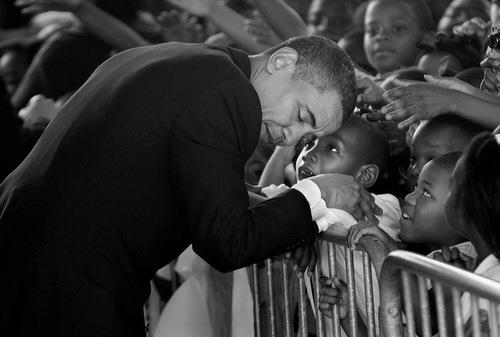
The President and the Children: Don’t Think First, Just Feel. Then Think.

There are pictures, and then there are photographs. And then photographs evolve to portraits, and portraits speak to identity and soul in ways that are irrefutable and powerful.

With every President of the United States, there emerges a portrait that speaks to the American people.  That portrait, that eternal visual of identity and soul, enters our collective consciousness and stays there.  It tells us who our President is, but also who we want and need him to be.

Marvin Eugene Smith recently shared this photograph of President Barack Obama on Faceboook, and added these personal thoughts:

See? We need more interaction like this between youth and their “stars.” Simple little gestures like this last a lifetime. Back in the day it was quite common. I’ve seen pics of Duke Ellington, Ella Fitzgerald, Sugar Ray Robinson, Sammy Davis, the Temptations, Count Basie and many others doing the same exact thing. No need for bodyguards to brush the young people aside who genuinely love you.

Mr. Smith is an African American man living in Chicago, and the series of social media connections that brought the President’s photo to his attention and then to a friend and then to me was made up of other African American men.  Some of you reading this immediately will jump on the defensive and say it doesn’t matter that black men see a portrait here, but you would be wrong.  Yes, anyone can identify with this image (I do), but the fact that it resonates and brings to mind other African American men and women who became children’s role models and heroes is critically important.

Look at those children.  Look at that man. Let yourself feel what it means, what it can mean, that magic moment of connection that clearly flows both ways across the fence.  He understands what they don’t yet, that who they dream they can become and how fiercely they believe in that vision is the lifeblood of this nation.  They just touched a man who leads the free world and who, figuratively, could be their father, their uncle, their brother, themselves.

As a mother and a child advocate, I now call this my portrait of Barack Obama.

(We do not all share the same portrait as “The One” that explained things to us about who the person was or is, and how his individual identity becomes part of our national identity. But we all know “our” image when we see it.  Following are some of my favorites, what are some of yours, and why?)

This is my top Kennedy portrait (I like this one because of the youthful energy and optimism, as well as the Jackie element in the bottom corner): 

This is my top Lincoln portrait, or others showing him literally in the battlefields of the Civil War (though frankly, any great photograph of that awesome craggy face works, too):

The pain here in President Johnson speaks to me about the agony of Vietnam, and the grief of a man who wanted to lead domestic policy and found himself drawn into an entirely other world.