Editor’s note: A skilled writer knows how set a scene, how to craft mood through tone and story pacing; my friend Margaret Ward McClain is such a writer. If you follow this blog, you will remember her gorgeous and heart-breaking essay The Simons House from 2011.
This week the Essays on Childhood project features her chill-bump-inducing remembrance of encounters, real and imagined, with alligators. Margaret returns to South Carolina and takes us into a place where danger is always just under the surface.
To get your mind right, read her short introductory reflection today and her full essay in installations throughout the week.
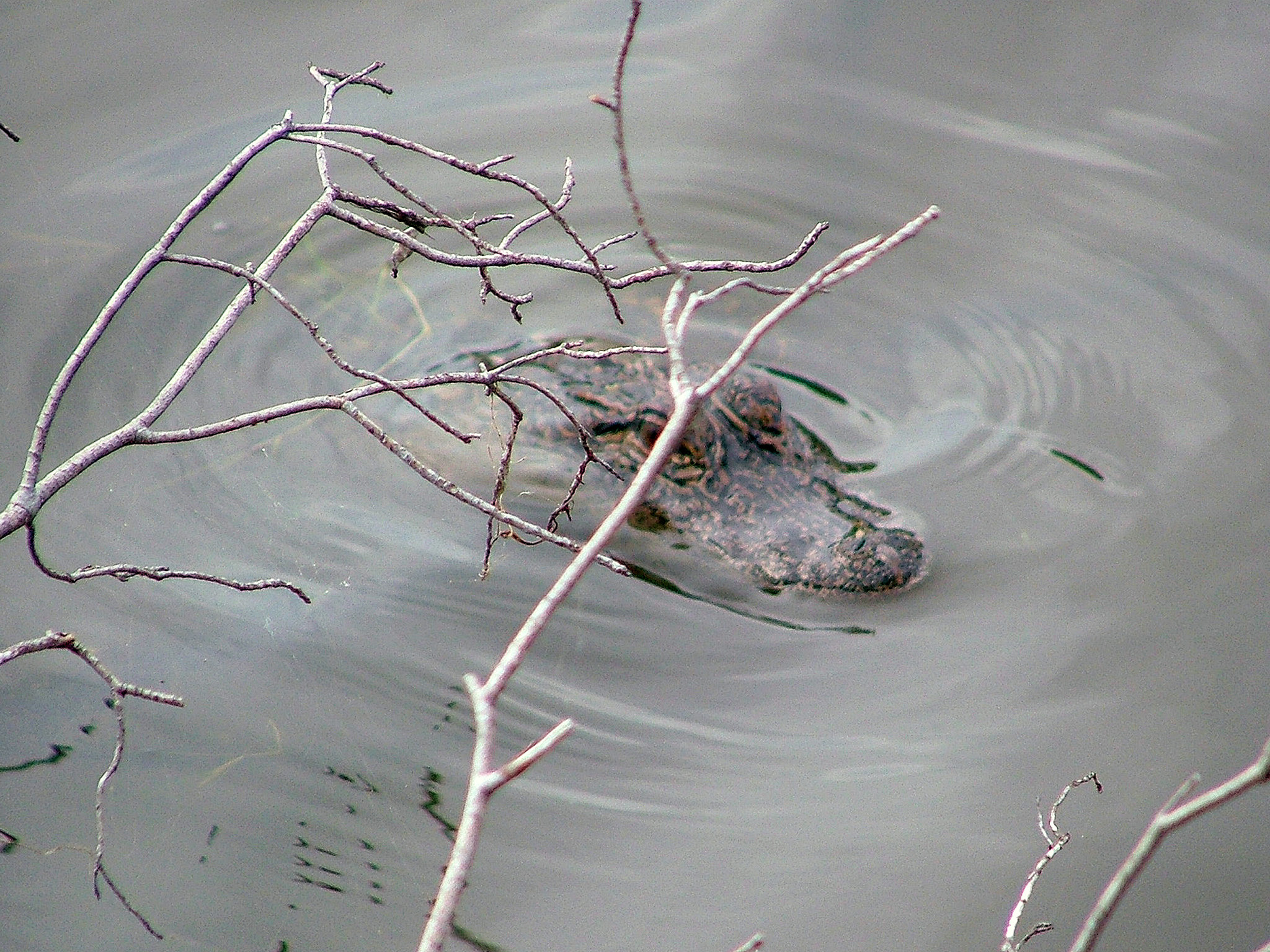
Copyright Tim McClain 2013
The American alligator (Alligator mississippiensis), sometimes referred to colloquially as a gator, is a reptile endemic to the Southeastern United States. It is one of the two living species of alligator, in the genus Alligator, within the family Alligatoridae.
The American alligator inhabits freshwater wetlands, such as marshes and cypress swamps, from Texas to North Carolina.
– Wikipedia
Dewees Island, South Carolina.
From my fishing spot on higher ground I snagged my line in the brush below. I made my way around a rice trunk and down a bank to free a fishing lure. It was a good one, hung up in the brush and no amount of cursing and yanking would pull it loose. Pluff mud sucked at my ankles as I tried to avoid a swim in the brackish creek. Stretching on tiptoe from the edge of the bank to the wax myrtle branch that snared the lure, I gave a few teetering yanks and pulled it free. Now, absently reeling in the line and grouching about the thick black mud on my shoes, I turn to head back up the bank. Just at the edge of vision I register twin knobs above the water and a thick, creviced plate between.
Not a stick.
In the flat brackish water at the edge of the impoundment, only the eyes are showing. Not a ripple gives him away. The surface of the water is a still mirror, reflecting marsh grass at the edge of a muddy bank and a flat grey sky. Here I stand, unmoving, instantly alert, hyper-aware. I feel the pulse in my neck as my heart beats faster. He hovers some 20 feet from the bank, about 180 feet too close for both of us. Only his eyes are visible. Safe in stealth and near-complete concealment, he has been watching me. Both now exposed and face-to-face we regard each other: he driven by primitive instinct to know if I am food; me frozen between rapt fascination and primal fear.
I was not raised to fear alligators. This is remarkable, considering the facts. Adult male alligators average about 11 feet long and can weigh 800 pounds, although some whoppers of 1,000 – 2,000 pounds have been reported. They are ingeniously designed predators. Alligators’ heavy, low bodies are armored with thick, ridged skin layered over bony scutes protruding like spikes. Venomous moccasins and rattlesnakes have trouble penetrating the hide with a bite. Swimming alligators are startlingly fast, propelled by an enormous tail that serves as defense on land. Champion sprinters, on land they can run nearly 30 miles an hour for short distances. Five claws on each front foot and four in back enable them to climb. They can scale short fences. Claws, tail, armor and speed are useful accessories for the alligator.
The bite is the apex of their predation. An alligator’s elongated snout is filled with teeth in a thick, bony skull with a hinged jaw angled so precisely that its bite exerts more force than ever measured in a land animal. Mobile garbage cans, they eat anything that registers as the right size, usually crabs, fish, birds, and smaller mammals too close to the water. Dogs and deer are fair game. Generally, they do not regard humans as prey. Generally may not apply to small children, swimmers, and anglers in the wrong place. Generally isn’t enough for me, my children, dogs, or extremities. My attitude towards alligators has changed. Respect and awe of their feral, prehistoric beauty has not diminished, but in time childhood excitement gave way to uneasiness and discomfort, grown up now into hair-standing-on-the-back-of-your-neck fear.

 Esse Diem