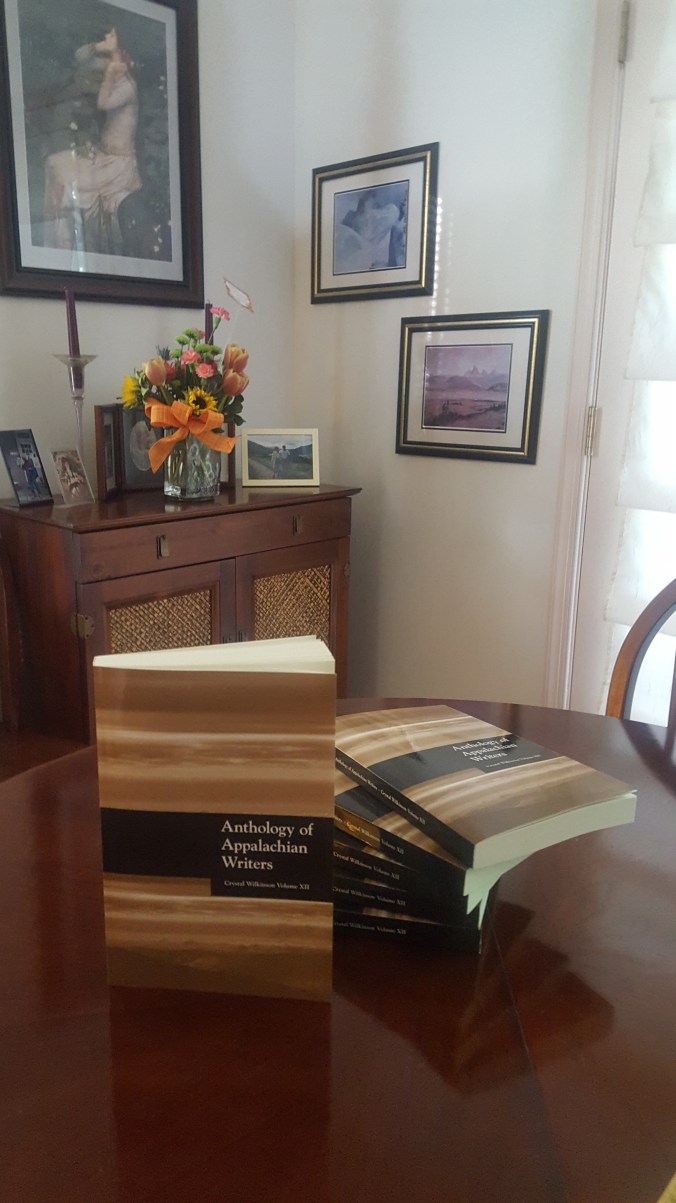
Anthology of Appalachian Writers Crystal Wilkinson Volume XII
I haven’t known what to say about having an essay included in the latest Anthology of Appalachian Writers. There are the simple and obvious things: This is an honor and a privilege; it means a lot to me; I am grateful.
But there are other things to say, too. Things that are more complicated and difficult.
When I saw the call for submissions, I thought of an essay I’d written five years ago while a student at WV Wesleyan College in the MFA program. I sent it in to the anthology with this note:
“This piece is about ethnic tensions between Italian and Polish immigrants in the Greenbrier Valley, WV. I recognize it might be a stretch for this anthology, but as an editor myself I know there are complexities in assembling a thematic volume or issue that really only make themselves known in the process.”
Only now, with this full book in hand, do I see how very un-stretched this essay is for this volume. In the prelude, “Everybody’s Street and Being Black in Appalachia: The Prose and Poetry of Crystal Wilkinson,” S. Bailey Shurbutt notes:
(Crystal Wilkinson says) “I’m actually haunted by the varieties of ways there are to be human in this world; and the variety of ways there are to live, to think.” The theme of madness also fits poignantly with the idea of being an ‘outsider’….
I got a bit lightheaded when I read that.
I told myself my essay was about immigrants and social class. Heck, I told the senior managing editor that. But I am reminded of Joan Didion’s words, “We tell ourselves stories in order to live.” And it takes some time to realize what your story is, and why you may be telling yourself a certain version at different points. When you see your story in a new way, you start to live in a new way.
My great-grandfather killed himself. And coming to terms with that has been and continues to be a long road. He’s been a papery ghost over my life, and only lately am I starting to put him to rest. As I’ve worked on truly seeing him, I’ve seen a lot of other things. Those things are not pretty, but seeing them is the first step to peace.
So back to my earlier thought. I am grateful. Just not exactly why I thought I was.
I hope you will order and read this anthology. It may help you see your own story.
News Release: Shepherd University Anthology Celebrates Affrilachian Writers
The 12th volume of the Anthology of Appalachian Writers, Crystal Wilkinson Volume has been released. The book is part of the series of anthologies that center around West Virginia Common Read Writers at the Center for the Book and the Appalachian Heritage Writer-in-Residence at the Shepherd University Center for Appalachian Studies and Communities. This year’s anthology celebrates the work of Affrilachian poet and Weatherford award winner Crystal Wilkinson, 2019 One Book One West Virginia Common Read author.
“This is our most diverse volume ever,” Managing Editor Sylvia Shurbutt noted. “We’re excited about the volume in particular because it reflects so well the work of Crystal Wilkinson, both a superb writer and wonderfully good-hearted person.”
The volume, supported by the WV Library Association, the WV Humanities Council, and the Shepherd University Foundation, contains writers from across the nation and the Appalachian region, including this year Affrilachian poet Frank X Walker, WV Poet Laureate Marc Harshman, poets Ronald Davis, Mark DeFoe, and Randi Ward, as well as fiction and creative nonfiction writers from around the state and the country.
This volume also contains the stories of WV Fiction Competition winners, Jessica Salfia, Jordan Carter, and Seán Patrick Duffy. Crystal Wilkinson selected the winners and wrote story critiques for all the finalists. Her critiques of Salfia, Carter, and Duffy are contained within the volume.
The book is an annual anthology, created by editors Dave Hoffman, Natalie Sypolt, and Allison Wharton. Copies of the volume can be obtained from Four Seasons Bookstore in Shepherdstown. During these Covid days, call Four Seasons, Monday through Saturday, at 304-876-3486 (between 10 am and 3 pm) or 304-240-9550 (you can text that number also) or shoot Kendra an e-mail at 4seasons114@gmail.com. When Covid restrictions are lifted the book will be available at other venues.
The WV Library Association distributes copies of the anthology to school libraries across West Virginia. For more information or questions, see the anthology website at https://www.shepherd.edu/ahwir/anthology-of-appalachian-writers or contact Dr. Sylvia Bailey Shurbutt at the Shepherd Center for Appalachian Studies and Communities.

 Esse Diem