This holiday weekend is a time when many people gather with those they love and trust the most. It is traditionally a time of fun, laughter, warm feelings, and full tummies.
It can also be a rare opportunity to speak in-person with the most beloved people in your life about an incredibly important topic, and that is end-of-life health care decisions. I know, I know, that is not what anyone wants to do. Personally, I am not convinced this weekend is the ideal time, given all of the other emotions and events that tend to swirl in the mix of family Thanksgiving traditions.
But it is a good time to think, I am certain about that. Look around the table, the living room, the front porch. Do you know what your parents want at the end of their lives? Does your partner know what you want if the worst should come unexpectedly? It is crucial now that we deal with a monumental change that grips modern life. I found the following line from an excellent article in The New Yorker by Atul Gawande to present the issue in a nutshell:
(My patient) was unmarried and without children. So I sat with her sisters in the I.C.U. family room to talk about whether we should proceed with the amputation and the tracheotomy. “Is she dying?” one of the sisters asked me. I didn’t know how to answer the question. I wasn’t even sure what the word “dying” meant anymore. In the past few decades, medical science has rendered obsolete centuries of experience, tradition, and language about our mortality, and created a new difficulty for mankind: how to die.
Until fairly recently, dying was a rapid event. It was rare to know one was facing terminal illness much before the end. Today’s health care environment brings many opportunities and much hope in many cases, but it has a side as dark and disturbing as anything I’ve ever read in the bleakest novels.
Dr. Gawande’s article is difficult to read, especially for those of us who have seen people we love battle on through Gulag-like regimens of “care.” The good news is that I see more friends who are ill choosing to die at home, with the human touch of the most important people in their lives. They can do this because they made the decision to establish a living will, and to communicate with their family and friends before anything happened.
I am participating today and through the rest of the weekend in the blogger rally created and supported by Engage With Grace – a movement aimed at making sure all of us understand , communicate, and have honored our end-of-life wishes. I especially am grateful to my friend Bob Coffield for this opportunity. His Health Care Law Blog is recognized nationally as one of the finest resources for current law and policy issues affecting health care. (He’s also a Twitter maniac. You can follow him @bobcoffield.)
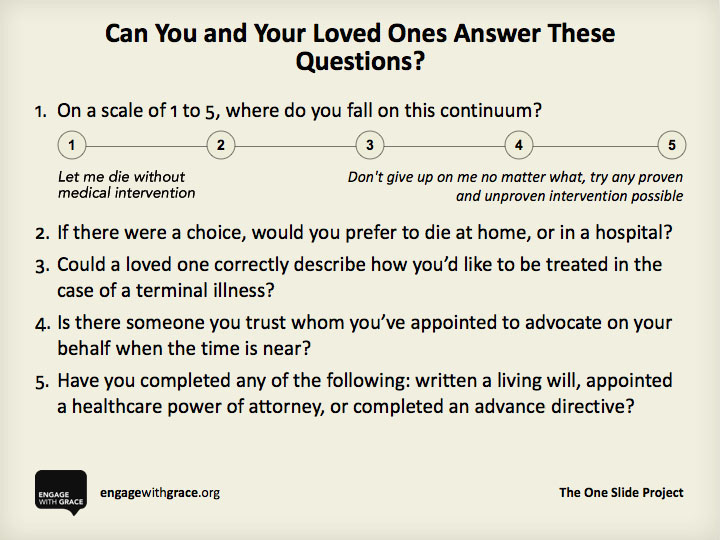
At the heart of Engage With Grace are five questions designed to get the conversation about end-of-life started. In the spirit of Esse Diem‘s commitment to Read Think Speak Write, I hope you will take the opportunity to do each of those things around this critically important issue.

 Esse Diem