The big old wonderful house burned to the ground. Uncle Kin died while I was a student at West Virginia University, and Charlie died a few years later when I was in San Francisco being mistaken for what Time magazine designated as a “hippie.” I hitchhiked home from San Francisco via Canada and made it to Grandma’s one day after she spent her first night ever alone.

This was me shortly after hitchhiking home from San Francisco in 1971.
Grandma and I lived together for a year. She helped me tame my mule, taught me family history, gardening, and the names and uses of wild plants. By example she taught kindness. I gleaned all the family history I could. I put new tar paper on the leaking cupola roof and replaced the rotting boards in the hay loft and cleared out the decades of manure that was causing rot in the big foundation logs. During that one summer with Grandma, my girlfriend raised hogs and two so-called hippies from Iowa raised an organic garden with 1500 tomato plants. A blight made sure we didn’t get rich on tomatoes.
Grandma died and I sobbed as I testified graveside that she was special, that without reservation she loved us all. She was our saint, our rock. Grandma Ethyl Atkins Barker and Uncle Kin Barker were saints who smiled into our lives. They both unconditionally loved us all, and for Grandma that even included one of our cousins who stole her pain pills.
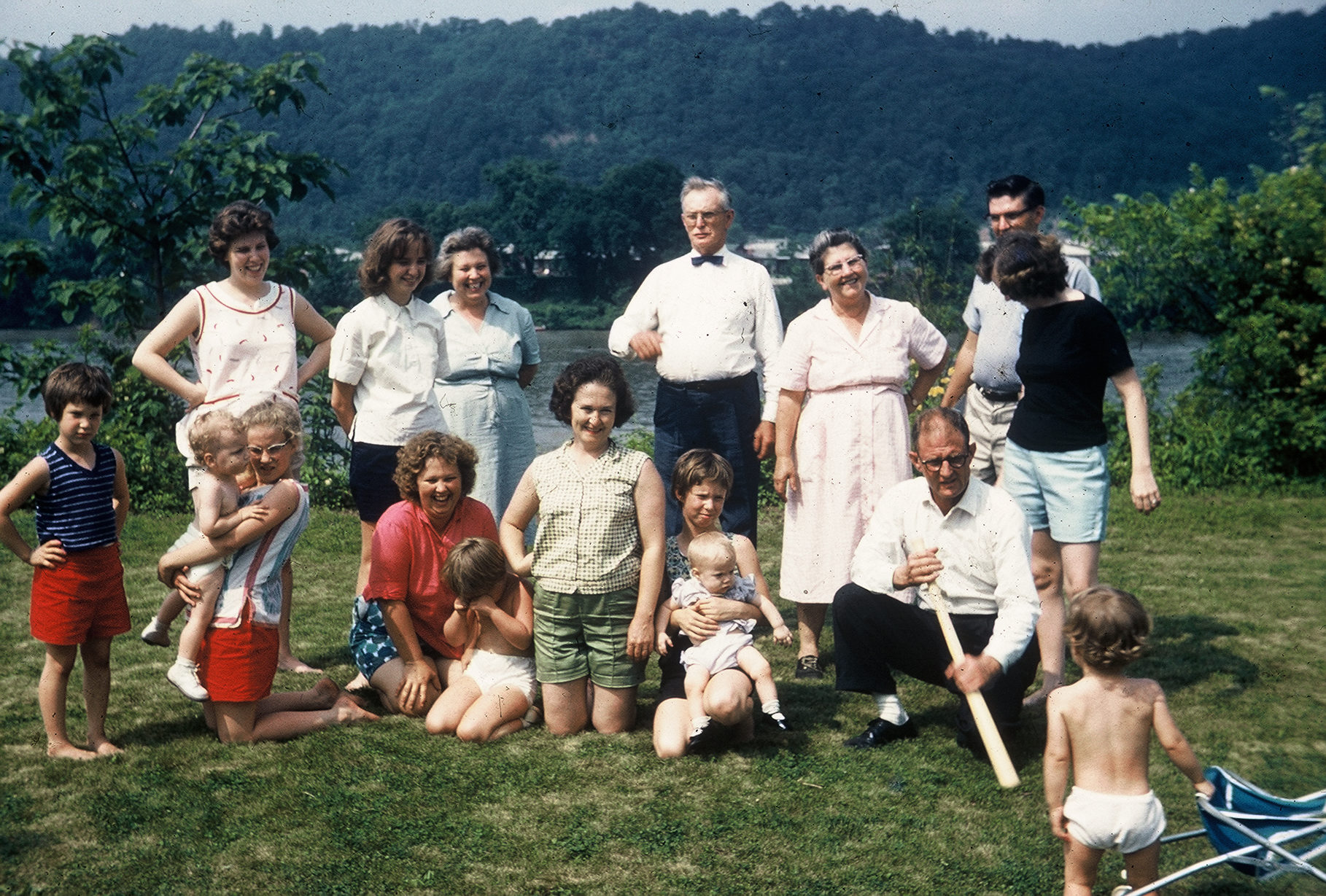
Some of Grandma and Charlie's progeny. Uncle Truman is in the back row beside Grandma who is beside Charlie. My mother is next to Charlie and Dad is holding the baseball bat. That is the Kanawha River in the background.

Uncle Truman in front of the barn, spoofing us, pretending to be a farmer.
Our home place is now under siege. Bull Creek is devoid of people, hardwood trees, ginseng, yellow root, and most other native plant and animal species. It is empty. The mountains above it have been strip mined along with my memories of Uncle Kin’s cabin and huckleberry picking. Ashford Ridge running from Ashford to Bull Creek has been scalped by mountain top removal strip mining. Behind our homeplace and just over the mountain on Fork Creek, mountain top removal strip mining is closing in on us.

Ashford Ridge, decaptitated
A distant cousin sold the mountain across the river from our homeplace to a coal company. It is probably too much hope to expect that it won’t be destroyed like Ashford Ridge and Bull Creek.
When Truman and I are gone, I hope the heirs love the homeplace like we do and resist the coal companies when they come with offers of money in exchange for Grandma’s farm. I hope they follow the example of our progenitor Isaac Barker, who told the man buying up mineral rights on Coal River: “You are Skinner by name, and skinner by trade, but you will not skin old Isaac Barker.”
Isaac spoke truth to power and refused to sell his mineral rights. My hope is that my stories and my family history will keep that truth-telling alive in future generations.

Strip mining on Bull Creek
All photo credits: Julian Martin
See A Better West Virginia for more on Blair Mountain and the history of coal mining and labor relations.
 I was born in Charleston, West Virginia, over four decades ago. Before I was fourteen years old, I had been to Bermuda, Quebec, Denmark, Paris, Switzerland, and Germany. I attended college in North Carolina, and before I graduated I had back-packed Germany, Scotland, and England. I worked on Capitol Hill my first year out of college, and lived and worked in the international university community of Raleigh-Durham-Chapel Hill for 10 years before making a conscious choice to move back to West Virginia.
 Esse Diem