West Virginia in Sunlight and Shadow: Writing an American Vignette

vignette (vɪˈnjɛt) – n.
1. a small illustration placed at the beginning or end of a book or chapter
2. a short graceful literary essay or sketch

I’m in good company having been rejected by Brevity: A Journal of Concise Literary Nonfiction (see “Wooing Brevity”); nonetheless, I dream of joining that other, smaller party — the one with writers who have wooed and won some DInty W. Moore love. Brevity is where a lot of CNF types like me hang out and admire fine writing. The journal publishes writers working in the extremely brief (750 words or less) essay form.

My 750 words were bounced back about two years ago, and I can say with confidence that my work has improved since then. I have a long way to go, but when I look back at what I sent to Brevity, I see one of my most egregious writing flaws glaring back at me, the tendency to stay in my own head and talk to myself on paper. I struggle with setting, with scene, with grounding events and people in a tangible world. I am learning how to create a place that a reader can enter and experience.

In Andrea Badgley’s call for submissions on the Brevity blog, I saw an opportunity.

Andrea Reads America: A Literary Tour of the USA is Badgley’s  effort to read literature by authors in all 50 states. She writes, “I want to see the state from different points of view. Whenever possible, I would like to read authors who are native to or are longtime residents of the state they set their fiction in, for whom the land is a part of their psyche.” American Vignette is the creative nonfiction component of her journey.

My vignette is about some of my experience growing up as a West Virginian. My family spans generations of Appalachian people. I have a loyalty to the state and an affection for it despite its many flaws that is difficult to explain. I’ve blogged about my feelings and their complexities on Esse Diem before, but with American Vignette I captured some of my favorite elements from a longer work. I also tried to make the narrative more reader-inclusive — to “teach the reader something” as one of my professors said — and not be satisfied with an internal monologue that just happens to be written. The original essay had ragged emotional edges. I was in a lot of pain when I first started writing about West Virginia, and it shows in my the early drafts. Revising those drafts and consolidating them into a sharper piece helped give me closure in some ways. My experience is still there and unchanged, but it has been tempered with time. I am becoming able to reflect and engage outside of my own distress.

For me, my essay is about losing my grip on an important place. It’s about hard questions and unknowable answers. I anticipate some people might be unhappy with this vignette and think that it is unfair or unkind to West Virginia. This is about my observations, experiences, and decisions. It is in no way intended to be the final word on anything, or even the only word. I hope my essay will generate online discussion. West Virginia is complex and contradictory. At times it is an unbearable series of shouts off a mountainside, the caller waiting for a response that seems never to come.

But we linger a little longer.

Our life has beautiful moments, and they are often good enough to disguise the oppression. Maybe we are good enough to ignore it in favor of what we love.​ We ​are tied to the land, to the creeks​, to the​ sky and hills. ​We are bound by ​a birthright and burdened by a collective pain.
The Water of Life

When the second prince had thus been gone a long time, the youngest son said he would go and search for the Water of Life, and trusted he should soon be able to make his father well again. So he set out, and the dwarf met him too at the same spot in the valley, among the mountains, and said, ’Prince, whither so fast?’ And the prince said, ’I am going in search of the Water of Life, because my father is ill, and like to die: can you help me?

— “The Water of Life” by Jacon and Wilhelm Grimm http://www.authorama.com/grimms-fairy-tales-51.html

Photo by Mabel Priddy

Photo by Mabel Priddy

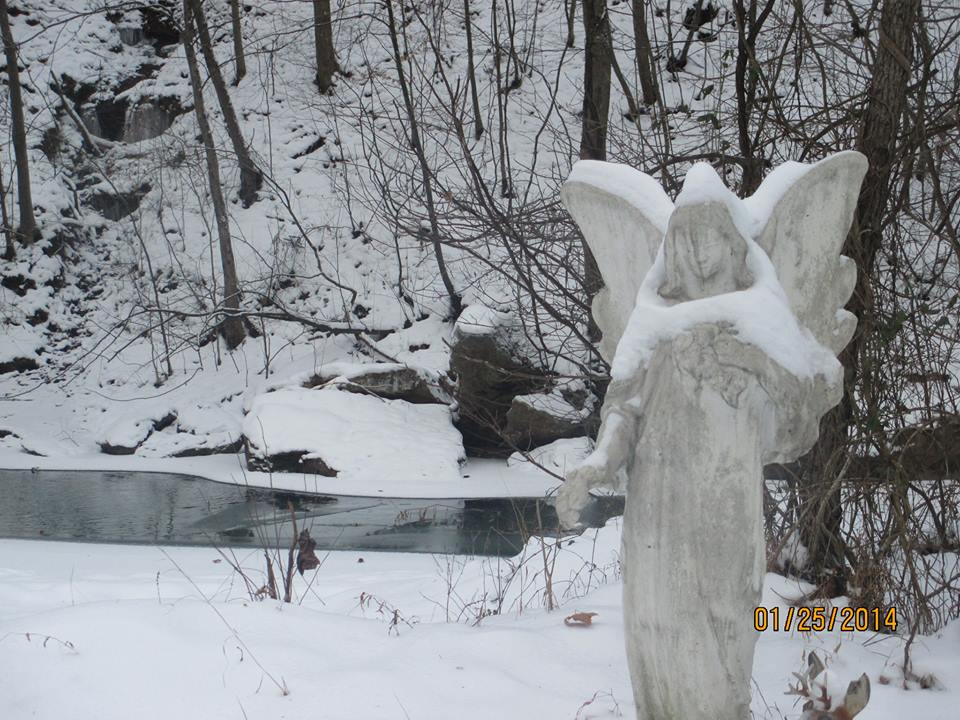
Hunt’s Hole at Witcher Creek, West Virginia. Long, dark, leafless branches reach to the water’s edge, lines of ink against the untouched snowfall that blankets the woods and marks the creek margins. Heavy rocks, large and small, sit with all their weight in the same position for generations. Used to be you could dive from the biggest rock right into Witcher Creek from this place. Teenaged bodies, skinny from nicotine and hard work, flying like sinewy prehistoric birds into the air and hanging, just for a moment, in the sun above the water, off the rock, frozen in that perfect pose and moment of  everything being right. Nothing can touch them in that place, that sacred place where you are not held down to earth by anything. You fly out over the Water of Life of your own volition, and you are weightless, and everything below you is just that, below you, and when you land you are submerged in something holy.

White marble statues of a baby deer and a blessing angel watch over the ever diminishing water; someone placed the guardians there after a young man in the community was stabbed to death by his own cousin for not going out to get more beer; that’s what my friend and her friends who lived out there and grew up there told me. My friend said the murdered boy was about the sweetest boy you could ever meet. She said that exactly, “He was about the sweetest boy you would ever meet.” She also said the cousin had spent time in jail for scalping someone. Took a knife to another man and pulled his outer self clean off his head.

This was the swimming hole and the baptizing place for many local churches.  My friend was baptized there. There was a man who used to climb up on the rock and dive into the water; he had no legs. How did he get up there? No one could remember, but they remember him diving, diving off the rock into the water that made people disciples of Christ. They remember the water used to come all the way out to the road. It was deep enough to dive in. It used to be.

I take some whiskey up there in my mind. I’m at Hunt’s Hole, on Witcher Creek. It’s summer and I’m in a two piece bathing suit. I drink and watch the sky, pull leaves off of branches and throw them like little scrap messages into the water. Standing up I roll my neck, then my spine, and pull up the bottoms of my suit. It’s foolhardy to drink and swim but no one else is around and I want to feel the water around me, want to feel that moment in the air. I fly, and I feel the warm air and precious minute where the world can’t hold me, I am free. Then I’m falling, and I hit the water, and it rushes over my head and pulls my hair out long and far behind my neck. I push up and burst clean and free into the outside world.

From the rock above I hear a boy shout, “Hell, yes!” I look up to see him, all bones, a stark frame against the suddenly-night sky, white and linear and I realize the water is too shallow now. “Stop!” I yell as loud as I can but it comes out a whisper. The boy freezes in his perfect moment, and another voice says, “Aw, shit, let him go.” My eyes track the voice to a man sitting on the rock, smoking a cigarette and laughing, his legless torso long and straight, my own legs now just ankle deep as I stand up to walk out of the water.