
Growing Up (part one) by Christi Davis Somerville

Editor’s note:  This essay holds a special place in my heart, as I spent a lot of time in my own adolescent years with Christi and her family at this homeplace in Loudendale, West Virginia.  I loved reading about the family history of the property, the incredibly funny descriptions of childhood antics, the portraits of Christi’s grandparents’ personalities and character, and the legacy of family ties that thrives in my old friend’s family today.  I was a “South Hills” kid and Christi was my only true friend in the Loudendale community.  I always felt that I had been granted a pass into special world when I would visit her home and her family, and so many years later I read her essay and realize that I was not imagining that.  This is essay is a gift that puts some of my own memories into perspective.

I believe you will love this essay, which is divided into several parts this week.  It surely had me recounting my own family blessings.

Christi grew up just outside the city limits of Charleston, West Virginia, in a middle class home with her parents and younger brother Bobby.   She graduated George Washington High School, obtained a BA in Elementary Education from the University of Charleston and an MA in Special Education/Gifted from Marshall University.

She married Rob Somerville in 1994 and quickly began teaching as an Itinerant Gifted teacher at Midland Trail Elementary. Christi confesses, “ I didn’t know what ‘gifted’ was at the time but I accepted the job any way!”  She taught Gifted for 6 years, serving  12 elementary schools from the eastern part of Kanawha County.

After a series of professional shifts within the education field to establish greater security for her growing family, she began teaching at Cross Lanes Elementary School (CLE) to be with her son when he started Kindergarten.  She now teaches first grade at CLE and her husband is the principal at Anne Bailey Elementary in St. Albans, West Virginia.  They live in Cross Lanes with son Brett who is in the 4th grade.

Growing Up

For as long as I can remember, I’ve felt a deep responsibility to preserve my family’s past, present, and future.  A self-proclaimed family keeper of memories, I dutifully planned and organized family reunions and kept meticulously detailed records of important family events, documenting each with lists of attendees and photographs.  I spent many hours hand copying a rudimentary family tree with sprawling branches in every direction, past and present, like wild lilac bush left unchecked.  However, my well-intentioned efforts all fell by the wayside when marriage, graduate school, my teaching career and a bouncing blue-eyed baby boy kept me from continuing my role as family historian.  Life happens whether it’s recorded for posterity or not.  Besides, the family tree, like the neglected lilac bush, kept growing and evolving wild as I lived my busy life as wife, mother, and teacher.

Not until just recently, a good friend introduced me to the world wide web of family tree research. Thinking this would be a great way to collect and organize all of my family collections, I jumped on the ancestry bandwagon, just to see what I had missed in those ten plus years of neglect.  In order to gain some insight into my own life, growing closer every day to what some refer to as “middle age,” I once again found my spark of curiosity and duty to preserve my family’s past for my family’s future.

I’ve researched for hours upon end the long-lost names, birthdays, marriages, and dates of death of past relatives I’ve never met, living in places I’ve never visited, looking for a connection with something I’ve never experienced.  I found myself wading knee-deep in scanned copies of birth certificates with strange yet poetic names, marriage certificates artfully hand-written in real ink, and death certificates stating causes of death I’ve never even heard of in this day and age.  It’s a daunting task really.  Trying to put it all in perspective—trying to match a name and face to my blood, seeing only hints of familiarity in foggy eyed photographs.  But, as I see it, without my relatives, without the sacrifices they made, I would not have had the tremendous opportunities I have had growing up in West Virginia.  In most of my research I discovered that once my relatives settled among the mountains, they never left.  Generations of my family have lived here—on all sides of my family—since the beginning, even before West Virginia was a state, and some, even before the United States had fought for its independence.  I feel somehow deep down in my soul that I owe them a debt of gratitude because, without my family, well, I simply wouldn’t be here now.

When I think of how I grew up as a generational West Virginian child, I can only imagine that my great grandparents never imagined the blessed life their great-granddaughter would be living.  I think about my poor great grandparents, Grandma and Grandpa Scragg, who worked all day long in the fields just to provide food for their seven children and a few others they had taken into their home to raise.  I think of my great grandfather Salvatore Scalissi, who came from Italy and spoke no English, who landed in a foreign world to make a better life for his family by working in the coal mines of West Virginia, alongside sons, brothers, and cousins.  These names and faces I see are so much more to me than just a wiggling leaf on my family tree.  They are my driving force to make my life the best it can be.

I owe it to them.

(Essay continued, next post.)
The Simons House (part 3) by Margaret Ward McClain

This is a story about a house.

Today, my walk in meditation begins as it did then, and I am as physically present in mind now as I was then in body.  I take a deep breath, then up the concrete step to the heavy wooden front door.  The door swings open to the ground level, a cinder-block and concrete first floor that anchors the wooden structure of the main house upstairs.  The air is still, slightly musty, cooling without the chill of air conditioning.  I start down the narrow hallway, past the laundry, past the dormitory-style ladies’ and men’s shower and dressing rooms.    A green beaded curtain separates the main living space from an extra fridge, a rusty freezer and piles of fishing equipment and hardware.  I pause to run my fingers across the smooth wooden beads, smiling at the click and shimmer of the absurdly avocado green strands.  Décor is a jumble of vintage yard-sale furniture and a cheery green-and-orange color scheme, best of the 1960’s floor-to-ceiling.   I move on past the brown-and-gold plaid polyester couch to the twin-bedded downstairs rooms:  sky-blue for my parents, orange for me and whichever itinerant family member would occupy the other twin bed.  Slightly curling posters and paint-by- number portraits of horses and ships line the walls.  A box fan sits in the window, turned backwards to pull the hot air out.  I turn the knob and a cross-breeze fills the room.   I sit for a moment on the narrow bed against the wall, drinking in the scent of salt, scrub pine and bay.

I would linger here, lay my cheek on the cool cotton sheets, drift off to sleep to the hum of the box fan and the murmuring ocean, but I have another place to go.

In the middle of the downstairs space sits the staircase.  The narrow wooden stairs are almost a tunnel, rising steeply and emerging abruptly from the floor on the second story into the main house.  My feet fall into the grooves worn on the stair treads by decades of flip-flops and sand.  Upstairs is a different world, all dark wood with bright borders of porches and windows.  To my left, three small bedrooms with creamy floor-to-ceiling bead board line up like soldiers, doors opening to the shotgun passage from front porch to back.  To my right is the small kitchen with its cracked linoleum floor and rickety butcher-block prep table.  Leaving the kitchen behind I turn for the open passage leading past the bedrooms to the great room and front porch.  The first bedroom has bunk beds (bunk beds!)  for the children, first me and my sister, later my younger cousins.  The middle bedroom, a room just large enough for the double wrought-iron bed, sheltered my aunt and uncle and let them keep an ear out for the children.  The front bedroom, for my grandparents, has twin beds and a window-unit air conditioner, then the only air conditioning in the house.

On my way down the passage I am caught, as I always have been, mid-stride, captivated.  A tall oak curio cabinet stands against the wall, honey-colored wood intricately carved, glass-front doors revealing shelves piled with a wonderment of shells.  There is a collection of hundreds, some carefully labeled with a Latin name on a tiny strip of paper, others stacked to overlapping.   Conch shells, purple striped urchins, varicolored mussel shells spread like wings.  Some are familiar, like an entire shelf of pale lettered olives, the South Carolina state shell, sometimes found on the island by the sharp-eyed and lucky.  Others are messengers from exotic shores:  giant conchs with porcelain-smooth pink centers, a curving cream-and brown nautilus, and tiny wentels spiked and whorled.   My mind is pulled past my horizon to another shore, where the life of these creatures begins, the thousands of watery miles of life and death between, the wave that carries them, the hand that carries them here.

I could spend hours here, gazing, but I move on.

Beyond the curio cabinet the passageway opens onto the great room, connected to the front porch by a door and a wall of double-hung windows.   It is paneled floor-to-ceiling with dark cypress furnished with white wicker, a Morris chair, and a lobster trap with a glass top serving as a coffee table.  I move to the center of the room, letting my glance drift across the walls decorated with netting spangled with shells,  yellowing Audubon prints of brown pheasant, a rowing oar above the passage to the upstairs bath and kitchen.  I step through the small doorway and let my fingers brush the knob to the pantry door, but I do not open it. Across the narrow passage is the upstairs bath, a small space filled with a pull-chain toilet and massive claw-foot tub perched on the bead-board on elaborate feet, enameled a spectacular shade of orange.

The passageway ends in the small narrow kitchen, connecting to the back porch with a door and a double hung window behind the stove.  Passing through the kitchen I end where I began, at the staircase.   Doors and windows honeycomb the upstairs.  Solid wooden three-paneled doors with round glass knobs connect each room with at least two others, windows open to the exterior, doors and interior windows open to the porches.  With doors and windows open, the lightest breeze has run of the house, ruffling bed sheets, stirring the sea-oats plucked and propped in containers for decoration, flipping cards on the table, sending paper napkins fluttering.  Closed up the house is a hollow tree, dark wood enclosing sturdy wooden doors and shuttered windows batten down to keep out the tropical weather.  In summer we lived with doors and windows flung wide, open to the light, open to catch the cooling breeze off the ocean, open to the beautiful sight of a distant storm.

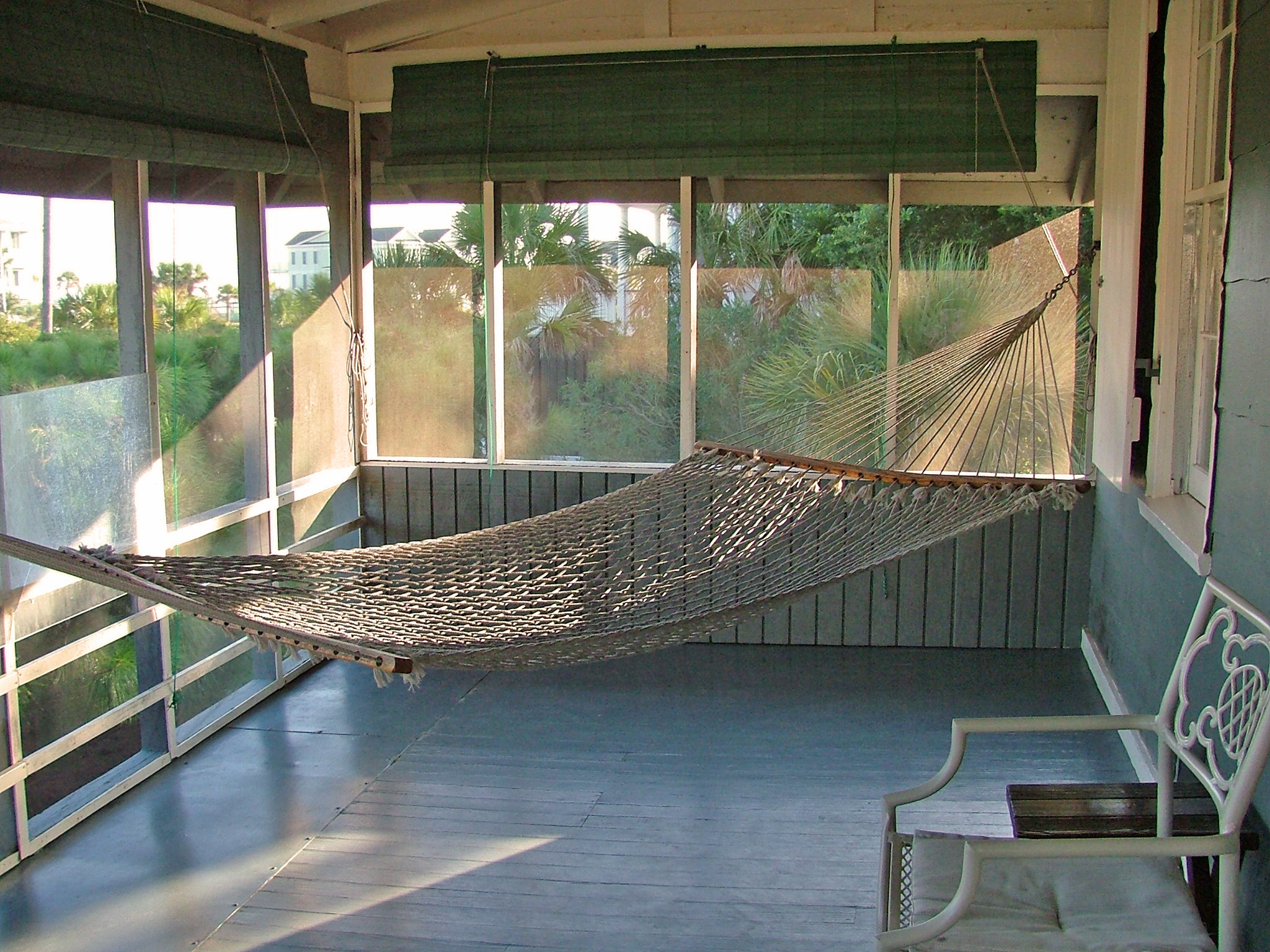
I return through the upstairs the way I came, through the great room to the front porch.  I step through the door into bright space, gray painted wood under my feet, sky-blue bead board above, ahead a lattice of white-painted wood and screen and beyond it the ocean.  The hammock hangs at the far end, a white curve of rope and wood against the gray, the rope’s open weave casting a patterned shadow on the floor.  A small green lizard napping underneath startles and skitters off to a shady corner.   Inhaling deeply, I smell salt and the ozone coming off the water, wax myrtle and bay and sand baking in the sun.  Sheltered for a moment under the crooked eave of the porch, I allow myself to think of my son.  Already half-grown, his long-limbed body would span the length of the hammock on this porch he has never seen.  He won’t know this house.  The voices that flowed through me many long evenings on this porch are as still as the summer night.

The losses began one by one, far from here, and rolled on unrelenting for year after year.

Now dates file in like headlines:   1989:  My parents’ fragile marriage finally crumbles.  1993:  my aunt dies of colon cancer at the age of 44, leaving my uncle widowed, my two cousins motherless.  1998:  my grandfather dies a painful death from bone cancer; two weeks later, my grandmother suffers a stroke that takes her movement and her voice but does not kill her until two years later, 2000.  2003:  my own marriage does not survive.  2005:  retired five years and remarried for only four, my uncle dies of pancreatic cancer at the age of 61, and my cousins are orphaned.  My mother and her sister have lost their nuclear family, alone but for my sister and me and my cousins, now two young ladies they have pledged to love.

The Clan is much diminished, and we who are left will never be the same.

Many families have the same story.  For us somehow it should have been different, because of the Simons House.  The house remains, unchanged, a physical place of us, where we were and became.   It should have done as it always did:  stopped the world beyond, shielded us, sheltered us together .  Today, when I walk through the house in meditation, I am alone.  What story will I tell my son?  That the price of love is grief and loss?  That lesson will come unbidden soon enough.  That precious memories of time spent with loved ones can fill a hole in your soul?

No, my darling, they cannot.

I breathe in deeply again, place my hand on the screen door, and push it open.  In a step I am outside on the deck above the trees, facing the ocean.  The door bangs closed behind me.  I lean against the deck railing and see the view as it was:  no new road, no row of million-dollar mansions between the old house and the ocean.  Just bare dunes crested with sea oats, blooming with mallow and lantana; a wide swath of creamy sand beach curving to the inlet; huge vertical towers of white cumulus clouds over a slate-gray ocean;  low tide, a few whitecaps barely breaking, flat and calm to the horizon.    A splinter from the wood rail bites my palm.  Through layers of past, present and future, the tactile presence of living in this place urges me on.

There isn’t time; I have another place to be.

Maybe it is another beach house, on another island.  Maybe it is a house on a lake, cool and green and blooming with flowers in the summer heat.   Maybe it is a log cabin above the river, the slow-flowing water the very color of my son’s hazel eyes.   There is a house where there is a family, where my boy is a child for a  moment.   I must be present.   I must make sure:  when he is grown and lies awake at night, when the price of love is paid in grief, there will be a door for him to step through, a place he can enter body and soul, and breathe.

(This is the conclusion of The Simons House.  Thank you for reading!  Previous posts represent parts 1 and 2. Click here to read about Margaret.)