VII.
My apprenticeship in learning to love this world has been long and slow. As animals, we all love the physical world, some with more suspicion than others. When this love becomes inordinate, excessive, the church calls it sin – avarice, lust, gluttony. Animal appetites that must be kept in check. Heaven has a way of doing this. Still, our bodies pull us.
I would love to be a gardener, to learn how to love and care for the land that feeds me, but I’m not. Moving as my family did left no time for gardening. A year and half in Nicaragua, before mother’s blindness, before the Contra began to kill foreign medical personnel; a year and half in Costa Rica, before my parents were caught in the middle of the UN and the Costa Rican government; a year and half of living in north Louisiana as my parents tried to get visas for Colombia, before deciding on the Dominican Republic. A year and a half leaves little time for a garden. And, when each of those year and halves are divided between three houses, there is no point even to try.
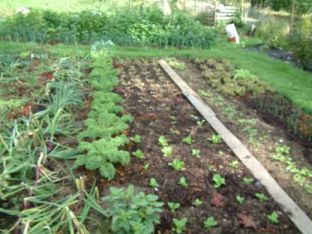 I’d seen gardens; eaten from them before. Neighbors in Rome, Georgia gave us tomatoes, okra, carrots grown in their backyards. The bungalow-style hotel we stayed at when we first arrived in Nicaragua had a banana right outside our front door; our first house, a mango in the patio. In Santo Domingo, an avocado. But these were not gardens to be tended, cared for. Other people did that; or, as in the fruit, it was there for the taking.
My father standing, machete raised, in the acrid smoke of plastic, dead rodent, human feces, and weeds is my first memory of a garden. An alley, that had once been a park with trees and benches, ran the length of our first house in Santo Domingo. Out of desperation to control the rats, to keep the path clean, and to shame the drunks who used the alley as their voiding ground and the neighbors who dumped their trash in the weeds, Dad decided that part of his mission was bringing civility and order to the alleyway. As I remember it, the work of civilization, of slashing and burning, of debris removal, of purifying fire took the full year we lived in that house. But it wasn’t all fire and sweat. At some point plants were introduced: Spanish Sword and Purple Heart. We children were enlisted to tend the fire, to move the broken, discarded cinder blocks, to water the plants.
How we hated the work; after all, we’d be moving soon.
Though an introduction to something like a garden, it did little to teach love of land and place. It taught duty. It taught toil. It taught vigilance against weeds. I’m sure that had we stayed in Costa Rica, things would be different. I remember, still, the drive down from the mountains of San José to the eastern coastal jungle. We went to visit a young Honduran agronomist, also a missionary. It seemed he knew every plant, that he could walk out into the growth and chop down a young palm to harvest its heart, barely checking to see if it was the right kind of tree. Had we stayed in Costa Rica, we might’ve gotten to know Carlos and Roxana better, might’ve learned to care for land in a different way, and might’ve lived in a country with no historic connections to the U.S. No William Walkers. No multiple Marine invasions. No puppet dictators.
If there was something in our family that always called us back to this present, physical world, if there was something we celebrated, it was food, sensual, fragrant food.
 Father loved the food of his childhood and mother didn’t simply oblige him, she lavished him with Bolognese from carrots, celery, garlic, and onions chopped and sautéed with ground beef, then stewed for hours in tomatoes, wine, and herbs. But it wasn’t all Italian all the time. Mother found a way into the cultures of those countries we moved through by learning to cook their food. She knows how to prepare green and ripe papaya, knows how four different countries turn avocado into dip, knows what to do with plantains depending on their ripeness.
The foods served at the family table are home, are comfort, are love and care. As a child, food is not something you think about. You instinctively accept it or reject it. I’m sure there were many meals beyond Omar’s hot dogs that we kids rejected. After all, mother worked hard to broaden our palate. What I remember, though, are not the struggles to get us to eat new food, but the hours spent learning how to make Nicaraguan tamales, the way she would ask questions of cooks, watch them to learn how they prepared foods like gallo pinto or picadillo. In our home, it was routine for lunch to include three, four, five extra guests – people who would appear at the door for a visit or consulta con el médico right as lunch was being served. If the fare were local, they would praise mom for her prowess. Otherwise, they would receive a culinary introduction to another country’s food. At the end of the meal, even the most tentative and shy of eaters would be won over.
Mom taught me to love saffron, cilantro, bread fruit. Taught me to cook, taught me only to barely ever follow a recipe, should instinct or lack of ingredients dictate otherwise. And she has passed on to me this love of food and cooking, this adventure into the world of the senses.


 Esse Diem