
Rob Boone
After a stint in the Navy, Rob began a nearly decade-long career in sales. Since relocating to St. Albans, West Virginia, from Tampa, he’s turned his sights to more creative pursuits: writing, acting, and designing.
When he’s not doting on his seven-year-old daughter, Jessica, he spends his time reading, writing, learning, and generally questioning the norms of the world at large. You can find him at RBoone.com.
Blogger’s note: This essay deals with first love, but it is not that simple. It takes you on a journey over many years, and asks you to live and then relive with the writer one of the most agonizing events and its aftermath that a young life can know. I believe this essay allows a unique view into the way young men can internalize their emotional world to such an extent that it causes them harm. I am awed by Rob’s courage, both in sharing this story and in the way he lives his life today. I am reminded that we so rarely get a glimpse into the private pain and triumphs of our fellow human beings…thank you, Rob, for sharing yourself with us.
Life and Love, the Inseparable | by Robert S. Boone
What follows is a story as yet untold to the blank page, and yet in the narrative of my life, is perhaps the only story deserving of being penned.
I was twelve when I first met her, standing on my front porch with Justin, debating a potential trade between Andre Dawson and Ken Griffey baseball cards.
Engrossed as we were in the possible trade, we didn’t hear the two girls walking towards us on the pavement, finishing a walk around the neighborhood block. When I looked up, I saw an amber-haired girl of about my age with a mischievous smile ask Justin if he wanted to climb trees later that day. He confirmed as I stood, mute. Soon they walked around the corner and disappeared. I asked Justin the name of the tall girl, and Justin replied, “Jess.” I kept repeating it. It rolled off of my tongue.
I spent much of the rest of that day in anticipation of seeing her again. Annoyed by my constant questions about her, Justin finally packed up his baseball card collection and led me to Nikki’s house.
There was a lone tree in her backyard, majestic if a bit weary, and a group of five bright-eyed conquerors would spend the next five summers abusing its branches in our race to the top. The finishing order was always the same: Nikki at the bottom, egging us on, Jess midway up the tree, Justin a smidge above her, Heather weaving her way from top to bottom and back, unable to maintain one position- and I perched on the top, heaving back and forth with all my might, begging the tree sway to my command, a combination of childish exhilaration and the adolescent urge to impress the girls.
Inside of me, something was happening, the significance of which no twelve-year-old boy will ever understand. I wanted to be around her, to be with her. That much I knew. I didn’t realize until much later that I was falling in love.
This love overtook me. At first, I resisted a bit, eventually succumbing completely on a cool spring day. I led her on a walk to the Front Street bridge, just a mile or so from home. We talked, though all the while I was desperately trying to summon the courage to kiss her. After what seemed like hundreds of attempts, I finally concocted a plan.
“I have to tell you something.”
“Okay. What?”
“It’s a secret…”
She shot me a puzzled look, and I told her to lean closer, as if, though no one was around, secrets cannot be uttered unless whispered in close quarters. When she leaned in, I raised my hand to her cheek, slowly tilted her head towards mine, and I kissed her. I believe to this day that, for just a few moments, the world actually revolved around us. Taking its cue from my heart, time stood still, until she pulled her lips slowly away from mine, and she smiled.
“I’ve been waiting for that all day.”
From that kiss, as I was hers, she was mine.
I realized then that I knew nothing of happiness before I saw the smile on the face of my Jessica Rose. The winds shifted a bit when she smiled, giving the world a moment to catch its breath.
Years later, on a blistering Valentine’s Day, just a few months after she had moved out of the neighborhood to Belpre, I looked outside my window and cursed. A blizzard was overpowering the town, and I had yet to see my beloved. I hopped on my bike and weathered the storm, arriving at her doorstep some fifteen miles later, with no feeling left in my fingers or toes. I knocked on her door with a single rose between my teeth, again cursing the cold that made my teeth chatter so hard I thought I might bite through the stem. I sat on her doorstep for thirty minutes, laughing, talking, and loving. Then I straddled my bike and set off for home.
She died the following winter. On November 9, 1997, she ran a red light, and was broadsided by a semi truck. She was killed instantly, as was one of her passengers, while another girl, a mutual friend, was badly injured.
Nikki called me that Sunday morning. Still asleep, I felt a slight alarm at Nikki’s sobbing, but was too groggy to attach any significance to it. She told me that Jess had been in an accident. My neck stiffened a bit as I sat up on the edge of the bed. Still, nothing registered. So she had been in a wreck? So what? This was Jess, after all. The idea of her being so much as injured was beyond my comprehension. I waited somewhat impatiently for the rest of the story, going over in my mind the idea of calling Jess soon to make sure she was okay.
And so I was unprepared when Nikki’s words came through the receiver:
“Robby… she’s dead.”
I don’t know what I felt in those first few seconds. Perhaps it was numbness. I suspect, though, that it’s more likely that I felt every emotion that had ever manifest itself coursing through me, until I couldn’t stand the weight of it, and I put my hand through the nearest wall in an attempt to somehow give the terror a chance to escape into the recesses of that wall. I dropped to my knees, and I sobbed (much as I’m doing now).
An hour later, still sobbing uncontrollably, we were in the hospital lobby with Jess’s parents, who gave the doctor permission to ask me if I wanted to see the body. They never doubted what Jess and I had shared, and they knew, somehow, that I needed to see her. I nodded. When they pulled her from the freezer, I couldn’t take my eyes off of her mouth. That very mouth that had breathed life into me so many years before was frozen in a look of horror, agape and stiff. That image is still very fresh in my mind.
That was my junior year in high school. If I ever so much as picked up a pencil for the next two years, I have no recollection of it. I was made to see a psychiatrist, who put me on anti-depressants which I pretended to take. Friends and family worried about me constantly, and had every right and reason to do so. My world had been shattered, and I saw no reason to participate in what was left of humanity, for she was the only member of it who had mattered. She had been my life, my love, my Rose.
I mourned with reckless abandon, as if grief were my only skill. If I loved her as much as I claimed, then I must grieve with the same intensity. To do otherwise was to tarnish not only her memory, but our love itself. I must not succeed in anything, for to succeed would be an admission that life could go on without her. I must not experience joy, much for the same reasons.
I adhered to this philosophy for longer than I thought possible. I did not succeed in anything. I did not experience joy. Indeed, I took a certain pleasure in my misery.
See, Jess?
Do you see how much I love you?
I am not willing to participate in life without you.
Aren’t you proud?
See how faithfully I am honoring your memory?
My negligence bore many side effects: wrecked relationships, strained ties with family and friends, and a descent into severe, and frequent, binge drinking to numb the pain. For years, I sabotaged every chance I was given at happiness.
Then I realized what a schmuck I’d been.
She wouldn’t be proud of me. She wouldn’t even recognize me. In fact, I no longer recognized me.
As I write this, I search for a moment- a singular place in time in which this epiphany struck, an external circumstance that would serve as a metaphor for the awakening. There is no such moment, however. The truth is much simpler: it was a choice. All that had been raging inside me dimmed to a dull flame, finally allowing for new growth, and the change had occurred, not through the influence of the world around me, but despite of it. I recall stumbling upon a quote from Carl Sagan:
“Who are we? We find that we live on an insignificant planet of a humdrum star lost in a galaxy tucked away in some forgotten corner of a universe in which there are far more galaxies than people.”
The universe was not standing still because I had lost my love; in fact, it did not care at all. Incredibly vast as it was, and the lives of two such tiny creatures so insignificant, the universe was completely indifferent. How amazing, then, was the fact that I had known her at all? If we are but a speck of dust in an inconceivable existence, how spectacular that she had walked by my house that fateful day and invited me to climb trees with her? I had known a love that most desperately seek their entire lives, and the odds against that happening were, quite literally, immeasurable. If rarity begets value, I had stumbled upon the most valuable piece of knowledge in existence, and that value resided inside of me, by way of her mere existence.
Not a day goes by that I don’t miss her. There are days, less frequent now, that still terrify me, because those are the days when I cannot for the life of me conjure the contours of her face. She sometimes appears as nothing more than a blur when I close my eyes. I carry her with me everywhere- to the grocery store, on my morning walk. Her memory is now a source of infinite wonder and joy, and those sentiments serve her memory much more faithfully than sorrow and misery ever could. As with any struggle, any misstep, any divergent road, the change came from within, because only by living is life truly honored.
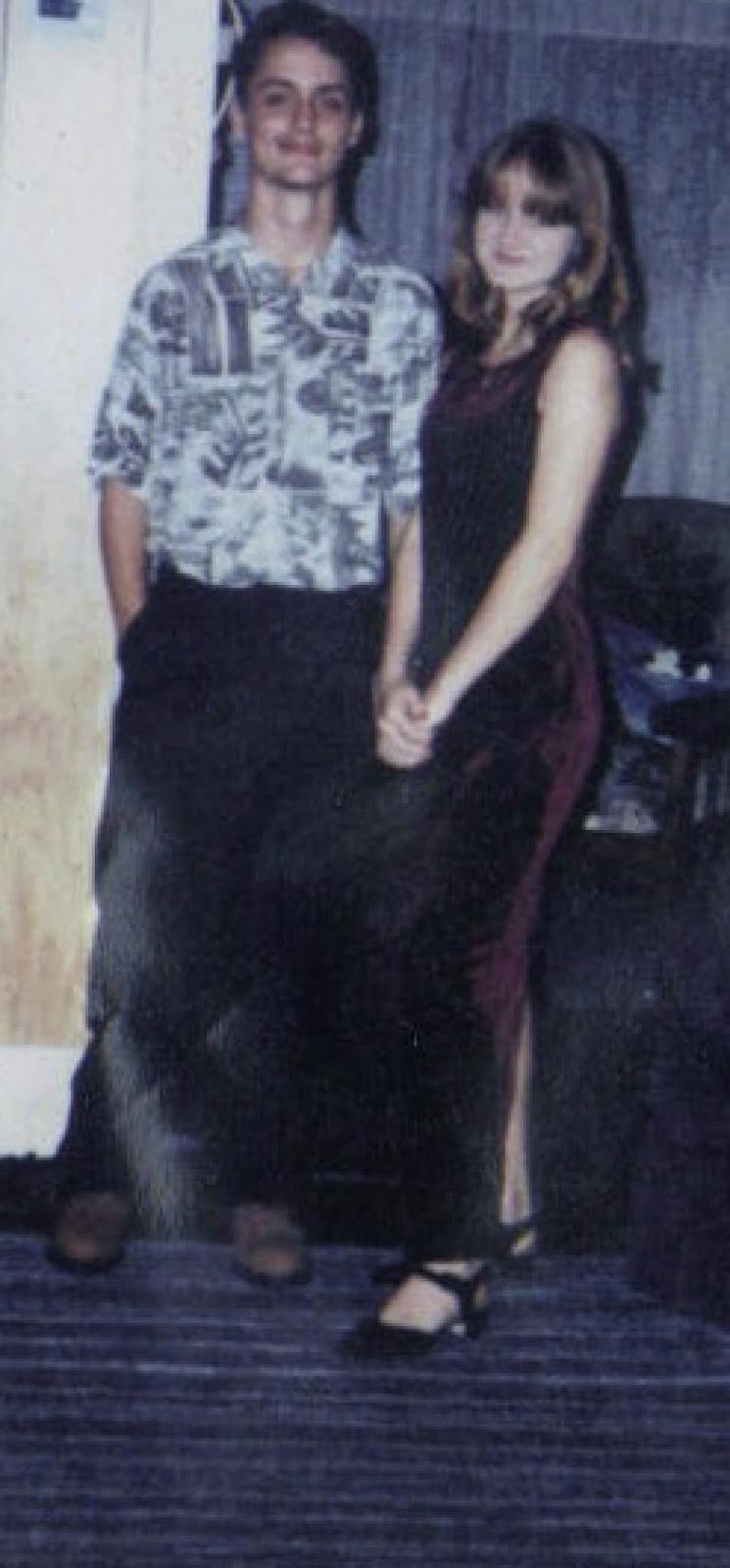
Robby and Jess
My childhood began as if on a hot-air balloon ride, and Jess was the flame that thrust me into the clouds. The view from on high was magnificent, and the world looked as it does from dizzying heights: sparkling, orderly, a perfect grid. That fateful November day, my flame died, and I watched my childhood come crashing back down to earth at a paralyzing speed, thrusting me into the mud and the muck so long forgotten. It was years before I had the courage to lift my head and look at the messy, chaotic world around me.
Once I lifted my gaze and began the slow walk back to reality, though, I realized that the love that we shared was still with me, and I walked (and still do) with the purpose of a man who has known the strength of love.
You can read more about the 2012 Essays on Childhood writers here.


 Esse Diem