Thoughts on Editing, and That Pesky Axe

I’ve always been an editor.  I’m probably a better editor than I am a writer.  Only recently have I become quite serious about advancing my talent in this area into a full-time professional job, and consequently only recently have I discovered an ugly truth:

Writers hate editors.

Since I am both a writer and an editor, it is often difficult for me to see what someone who just wants to write sees about the editorial process.  If you aren’t careful, you can isolate yourself from a writer so completely and so permanently that you never work together again.

Therein may lie the key word, together.

The writer works alone to produce his or her work.  Then the editor works alone to review the work for issues that stand in the way of the most complete, effective product possible.  When you return an edited piece to a writer, you must hand it gently, and kindly, and with a clear understanding that the outright corrections and strong suggestions are not a commentary on the person who penned the original words.  This is very difficult to do, and requires a two-way relationship.  I can do everything I know how to do to deliver constructive criticism well, but if the writer is defensive or completely unable to view his or her work objectively, things are not going to work.

Jim Kelley has a good article on some of this difficulty.

Unfortunately, the craft of cutting is undervalued in a world where writers are paid by the word. And it shows; you don’t have to look very hard to find padded work in print. Yet clearly it is precision which separates the journeyman from the master. Perhaps the way to grow as a writer is to shrink your manuscripts. Or, as Sir Arthur Quiller-Couch so memorably put it, “Whenever you feel an impulse to perpetrate a piece of exceptionally fine writing, obey it whole-heartedly and delete it before sending your manuscripts to press. Murder your darlings.”

The concept of “kill your darlings” (as an agent paraphrased at the James River Writers conference this month) is a spot-on metaphor for how writers feel.  I know the feeling.  I’ve written pages that I love, and yet they do not support the story well.  Sometimes it’s not even a series of pages, it’s a beautiful paragraph to which you are very attached, that you believe expresses something important and reflective of your identity.  The hard truth is, if it doesn’t belong there, someone has to ax it.  It’s not usually the writer, it’s the editor who gets blood on her hands.

I take seriously the joy of writing.  I would never deliberately squash the happiness of someone who is discovering the satisfaction and self-awareness that writing can bring to life.  This is a two-way relationship though — I have a role, and the writer has a role.

Old Yeller would not be the same story if the boy who loved the dog most hadn’t been the one to pull the trigger.

Love your writing enough to know when something has to change.

(What are the qualities of the best editors you’ve had?  The best writers?  What do you think contributes to a writer’s ability to hear an editor’s advice, and what helps an editor be effective with writers?  Are there just some things that won’t ever evolve past a certain point?)
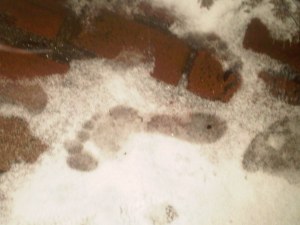
A Long Walk in the Snow by Roger D. Johnson

I don’t know Roger Johnson, but he left this fascinating story as a “comment” on the blog A Better West Virginia.  I am not sure it is truly an essay, but it is an interesting story that raises questions about how adolescents make choices, how strangers change our destiny, and what it can be like to grow up in a place like the one and only West Virginia.

I hope to learn more about Mr. Johnson someday, but for now, please enjoy this reflection on how a young man’s life was saved one cold and wintry night by two coal miners who stopped to help.  Young people sometimes make bold decisions that later turn into life-threatening situations.  To me, this story speaks to the kind of people who make West Virginia a special place — people who know when and how to intervene, and who often just as quickly as they materialize disappear forever to remain mysterious and life-changing memories.

A Long Walk in the Snow

In the late Fall or early Winter of 1961 when I was a Junior at Nicholas County High School, my cousin, who was a Senior, and I caught a ride from Dille to Summersville to go to a basketball game at the high school.

We went to the game where he met his girl friend and I hooked up with a girl I knew. After the game we fooled around outside the old main building for an hour or so, then the girl I was with had to leave with her parents.

It was a warm night as we walked his girl home through town. Just outside of Summersville he told me to wait while he took her home down one of the side streets.

I waited for an hour and it was getting cold, so I started walking down the road. I figured he had decided to spent the night and I guessed I could catch a ride to Birch River. I was dressed in a light weight white coat with no hat and cheap shoes but it was getting colder and starting to rain lightly so I kept walking.

About midnight I was below Muddelty where there was a sawmill and a fire was burning in some old slabs. I walked in there and built up the fire. I sat on the ground as I warmed myself for about 30 minutes and began to doze off to sleep. As the rain turned to snow, I started getting home sick, knowing my Mom would be worrying about me.

I left the warm fire and walked down the middle of the road in a gently falling snow. By the time I reached the foot of Powell’s Mountain the road was covered with snow and I was pretty much soaked. It was a slow walk up the mountain and the snow was 6 or 8 inches when I reached the top.

Cold and tired I crawled in the old bus house that someone had turned over on it’s side. I was trying to decide whether to take the dirt road across the mountain to Dille. They now call that the Henry Young Memorial Highway. It was much closer to home but I knew it was wild with very few houses on the road.

Curled up in a cold ball in the bus house I was just going to sleep when I heard a truck coming up the hill from the direction of Muddelty. This was the first vehicle I had seen all the way from Summersville to the top of Powell’s Mountain. By the time I could crawl out of my shelter the truck had reach the top and pulled off right in front of me. I walked around and knock on the window of the drivers side. The poor driver nearly jumped out of his skin when he rolled down the window and saw me standing there in my white coat with ice crusted on my hair. “Where the hell did you come from?” he finally said.

The man who picked me up was on his way to work in the mines and said he pulled off to see how bad the road was before he went down the hill to Birch River. It was a slow slippery ride but I only cared about being in the warm truck. At Birch River he let me out on the corner because I was going to Dille and he was going to Tioga, I think. I never did get his name.

Slightly warmer, I stood there for half an hour before a car came along headed my way. I stuck out my thumb and another miner picked me up and took me all the way to my house. I walked up the hill in a foot of snow and into the house which was never locked. It was 4:30 in the morning.

Mom got up as soon as she heard me come in. She saw the shape I was in and put on a pot of coffee. While she found me dry clothes I drank two cups of hot coffee. I went to bed about 5:30 that morning and didn’t get up until the following morning. I had to go buy a new pair of shoes because there wasn’t any sole left on my old pair.

I thanked the 2 coal miners who gave me rides that long night but I have often wondered what would have happened if that man hadn’t pulled off before going on down Powell’s Mountain and I had gone to sleep in that old bus house.

I think my history would have ended at age 17.

Image credit:  Elizabeth Gaucher