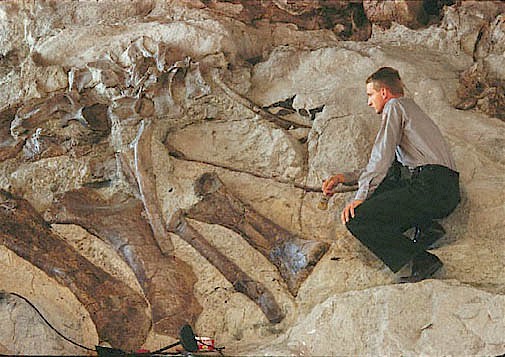
 From “When Was the First Dinosaur Discovered?”
Way back in 1676, Robert Plot, the curator of an English museum, described and drew a thigh bone that he believed belonged to a giant man. Although that fossil disappeared without a trace, the surviving illustration suggests that it may well have been part of a “Megalosaurus.” Later, in 1822, large teeth discovered in England by Mary Ann Mantell and her husband, Gideon, were thought to be the remains of a huge and extinct iguana. It wasn’t until 1841 that British scientist Richard Owen came to realize that such fossils were distinct from the teeth or bones of any living creature. The ancient animals were so different, in fact, that they deserved their own name. So Owen dubbed the group “Dinosauria,”which means “terrible lizards.”
My friend Sara hooked me up with this TED video that explores issues of schools and creativity – more specifically, does our educational system and prevailing philosophy create such a fear of failure that children are dis-incentivized to take the very risks of failure that lead to break through discoveries? It’s a really good watch and listen, but my favorite part was this simple concept:
If you are afraid to make a mistake, you will never create anything original.
My child is deeply in love with dinosaurs right now. As we were playing the other day and I explained the first dinosaur discoveries, how they were made, what people first thought, etc., I was overcome with how absolutely insane the first people to publicize theories about their paleontology must have appeared. Talk about risk!
OK, we found these bones. They are really big. No, bigger. A bit bigger. Right. That’s what I said, yes. No, more like reptiles. Not really sure yet. Uh huh. No, pretty sure they were in the air and water too. Looks like just about all over the world. How long ago? OK………are you sitting down?
Creativity is not just about art. Creativity is, as Sir Ken Robinson explains in the video, at its core about the willingness to be wrong; maybe more than a little bit wrong. It’s that risk that leads to new discovery, to shifts in our understanding of what is real and possible that have the potential to change everything we think we can do.
This year, let’s support more students in their willingness to take risk, and to be wrong. We may say that’s not what we expected, is it? Way to go trying to figure it out on your own.
I’m proud of you for taking that risk.
Image credit: Land Use History of the Colorado Plateau


 Esse Diem