Everybody Crying Together

Very young children express their feelings and observations with such raw honesty and unfiltered emotion, if we truly listen and are willing to hear we can connect our clouded minds to some amazing things.
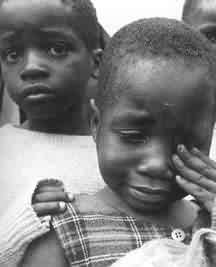
Compassion means shared suffering, not simply feeling sorry for someone else.

At my daughter’s play date with one of her closest companions last week a bit of a classic two-year-old confusion erupted.  Her friend happily asked her mother to read books to all of us.  Then she picked up one of my child’s favorite books, and my child reached for it and started flipping through the pages.  Her friend tried to take it back, there was resistance, then frustration, then protest, then crying.  Lots of crying and wailing and heart-rending distress ensued.

I watched my daughter’s eyes shoot back and forth to her friend and the two mothers in the room.  She wasn’t about to give up her book, but she wasn’t entirely sure what the problem was, either.  I saw her struggle to understand, and then by choice join the crying.  The somewhat amusing thing was she still didn’t seem to know why her friend was upset, but she was going to cry because her friend was crying. 

The words she said were, “Everybody crying together……….everybody crying together…….”

We mothers knew we had to help change the channel quickly, if for no other reason than we were about to start laughing and we didn’t want to throw fuel on the tiny meltdown cases in our care.  We whisked them up and went to another room for another activity, and all was well in very short order.  (I recall chocolate also was administered.)

When I did some searching on “crying together” it suggested that we cry together fairly easily when we are happy, and not easily but often when grieving a shared loss.  I wonder how often we cry together to express compassion.

Compassion (from Latin: “co-suffering”) is a virtue—one in which the emotional capacities of empathy and sympathy (for the suffering of others) are regarded as a part of love itself, and a cornerstone of greater social interconnectedness and humanism—foundational to the highest principles in philosophy, society, and personhood.

Mother Teresa said, “If we have no peace, it is because we have forgotten that we belong to each other.”  Forgotten.  Perhaps we are born knowing, and we spend a lifetime forgetting.

I’m sure someone with a degree in child development or some related psychology field can explain to me why what I saw was just a toddler tantrum; unfortunately I can’t hear you, I’m too busy listening to a child and making a pledge to be less concerned with why those I care about are upset, and more focused on being present with them when they are.

(The beautiful image used in this post is from Children: The World Affairs Blog Network and the entire post can be viewed at http://children.foreignpolicyblogs.com/page/81/.)

The Creativity Crisis, or Where Have All the Grown Ups Gone?

Newsweek magazine has a great piece out right now on The Creativity Crisis.  It makes many excellent observations that go beyond the scope of this post, but one particular concept keeps hovering in my mind, and I wonder if anyone else ever thinks about this kind of thing: Is it possible we aren’t really growing up at the same rate we used to?  Could it be that even as technical adults we are parenting with an adolescent mentality that is smothering our kids’ capacity to develop their creativity?  Children model what we do, not what we say.

Getting older doesn't always mean getting wiser.

“The accepted definition of creativity is production of something original and useful, and that’s what’s reflected in the tests. There is never one right answer. To be creative requires divergent thinking (generating many unique ideas) and then convergent thinking (combining those ideas into the best result).”

The article talks about how children today are scoring lower on creativity tests, and ponders if too much TV time is to blame.  Surely our lock-step consumer culture that feeds conformity and insecurity to children must play a role, but I think who’s spoon feeding that culture might, uncomfortably, be a bit closer to home.  A lot closer.

“Kim found creativity scores had been steadily rising, just like IQ scores, until 1990. Since then, creativity scores have consistently inched downward. ‘It’s very clear, and the decrease is very significant,’ Kim says. It is the scores of younger children in America—from kindergarten through sixth grade—for whom the decline is ‘most serious.'”

I am very frustrated by my own experience with a negative environment around divergent thinking in some of my adult peer groups.  These are not necessarily my friends, but sometimes they are.  And oddly I think I could also track the beginning of the end of comfortable disagreements between social friends and colleagues back to about 1990, the year the creativity tests started showing significant declines in our children’s abilities to think like innovators, inventers, and problem-solvers.

We used to be able to hash things out, have a drink and move on.  But there is an edge to many conversations now that feels a lot less open and trusting and confident.  I’ve come to identify what I call simply “The Look.”  It’s what I get every now and then when I express too many thoughts or ideas on a subject I thought was open for discussion, and apparently is not.  It could be mountaintop removal, or marriage, or art, or even whether or not this french toast is as good as it used to be.  The Look says you’ve crossed a line.  I am now suspicious of you.  You are saying things that open cans of worms and you really should stop now.  But it’s too late.

Things are never really the same after The Look.

I have an unprovable theory that since as a species we are living longer, we effectively have extended our developmental adolescence.  Growing up takes longer.  Taking on responsibility is delayed.  And in this murky man-child world, we are more insecure than generations before us about openly exploring divergent thinking well into our adult years.  As a group, we are more susceptible to bringing an adolescent mindset to disagreements, and therefore more easily pressured into squashing down the divergent thinking process as soon as it hits a peer pressure wall.  If this is true, it’s wreaking havoc on multiple up and coming generations in ways new and unpleasant, with consequences we have yet to discover fully.

Clearly, there are other dynamics at play.  International anxieties, the economy, the rise of the political far right, and the counter energies of the far left — all come together, then apart, then reconnect over and over again as they have around the world for centuries.  Except this time it’s us.  The good ole U.S. of A.  And it’s a really bad time to be inadvertently raising a generation of conformists who are afraid of the shadows of their own thoughts. 

Let’s have that drink and move on.  I’m buying.