Copyright Tim McClain 2013
In the Dream
It’s starting to get dark, and we have to get my grandparents’ belongings from the house. They are gone. No sense of their presence remains. The house is a hollow shell for the objects left. A moving truck is parked out front right down to the brick porch. Several cars are under the spread of the live oak in the yard. My son has gone down by the lake. He’s just out of sight but I know he’s playing on the mossy bank near the spot where the wooden boat rested. I’m standing on the front porch, talking with the movers about how to get the furniture out. Inside the house is full; the front door is small beside towers of beds and tables, books, photographs, a piano. There are two men. They are looking over my shoulder at the curve of the lake beside the house, confused, but not alarmed. One man looks at me and says, “but what are we supposed to do about the alligators, ma’am?’
Turning around to the lake, I see dark forms massing. Not to the bank yet, but getting closer. How many? Close to the bank is thick with them. Eyes and scutes are visible above the water. Beyond the bank are V-shaped trails of ripples in the water where others swim, mostly submerged, and beyond the ripples are bubbles where yet more lurk below the water. Waves upon waves. The sight horrifies me to my bones but is somehow familiar, a fierce and unpredictable storm of a kind I’ve seen before. My answer is matter-of-fact. “We’ll have to hurry. We’ll have to get things out before they get to the yard.” In that moment I am conscious of my son.

Copyright Tim McClain 2013
I move through the house to the sliding glass door. I can see him outside playing at the bank. He is five, maybe six years old, all blonde curls and soft small hands. He is bending the cattails down, pulling open the brown velvet pods and blowing the fluff across the water. He does not see the alligators swimming across the lake, the alligators approaching the bank, the alligators heaving their bulk from the water. I see them, feel their mass. I don’t scream, don’t yell to him, don’t make a sound. If he makes a sound, they will have him. I yank the sliding door open and run, run like I ran to catch up with my grandfather, legs churning. I make it to the holly tree outside the back door, then to the towering camellias, looking for the grass to turn to moss under my feet, then I’ll be almost there when there’s the moss by the bank, and the moss crushes under my feet, and I have him. I pull him to my chest and run, pressing his face into my shoulder so he can’t see them, his damp curls on my neck, his feet dangling past my knees. My arms ache with his weight and I run. The reptiles are black and slick from the water of the lake and gathering like clouds. My path to the door narrows to infinity until suddenly my foot hits the first step and we are inside and banging the glass door closed behind us. There is no breathless relief at our escape, no emotional release after the grip of fear. We are safe; that is all. I set my son down and he looks up at me, nearly expressionless, all large eyes in a pale face. I wrap his hand up in mine. He knows that I have done what had to be done, all one can do when the alligators come, and now it’s time to go.
When we turn around the room is neatly arranged, each book and photograph where it belongs. The house is dark as we walk to the front door. I place my hand on the brass-colored knob, worn from decades of touch by many hands. It is loose in my grasp and I turn it, hear it click and pull the door open. It is night, and the thick LowCountry darkness has settled, obscuring any view beyond the threshold. Outside is a wave of sound of the frogs and cicadas, blackness and the thick humid air wrapping around my face. Staring hard into the dark I try to pick out the outline of a seething black mass, a shape darker than the darkness that will force us back into the house. Nothing reveals itself to me in the dark. We are drawn to leave the house by a force like a magnet. The car is in the yard under the live oak. If we go, we can make it. My child’s hand in mine, I push the screened door open with my palm and we step over the threshold, pushing into the night wave of heat and sound, unseeing.
Dewees Island
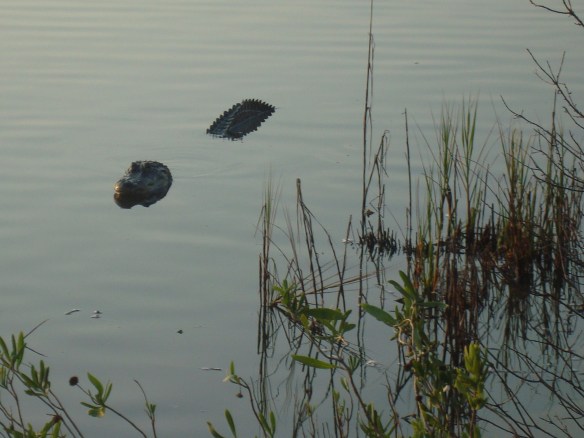
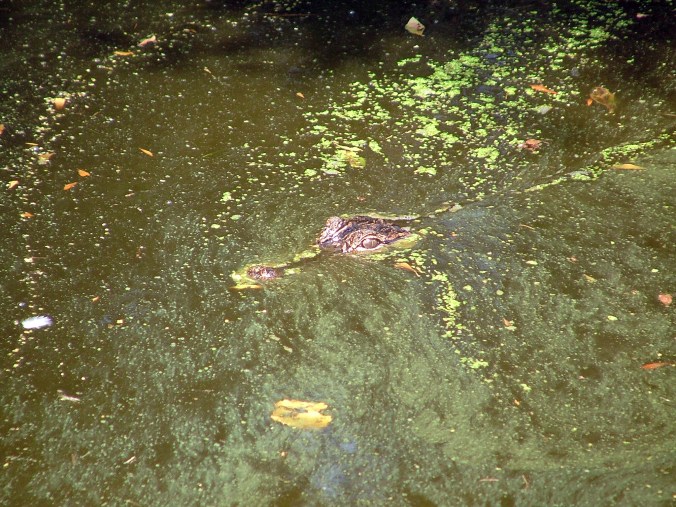
Shit. The hair on the back of my neck stands up and my mouth goes dry. “Breathe, breathe,” I tell myself, “back up slow, no sound.” Eyes locked on the black marbles of the alligator’s eyes visible above the water, I move one foot, then the other. The alligator moves no closer but holds his ground, floating just beneath the surface. Thick and numbed, my fingers let my fishing rod slip down and catch in the mud and I stumble. Catching my weight my foot hits the mud bank behind me with a resounding slap. Movement blurs in the water; instinctively I startle and turn towards the sound. An anhinga rises in improbable flight from under the surface of the water. Slick feathers slip free of the water, breaking the surface tension, pulling air beneath wet wings, making an ungainly flapping commotion. In seconds the bird lifts into the air, transformed from a sleek swimming machine into a sodden parody of flight. Listing on heavy wings it flies above the marsh grass and crashes to roost in a tree. For seconds my gaze has strayed from the alligator. When I look back he is gone, vanished as if he were never there.
My heart is still pounding when I hear the whir of a golf cart coming up the path above the bank and my son shouting. “Hey Mom! Mom! What are you doing down there?” My son and his best friend are tooling around the island. He stops the cart and kicks back behind the wheel. Propping one foot on the dash he looks at me from under his baseball cap with amused condescention, a look that should be patented by 16 y.o. boys. “You catching anything?” he says skeptically. I start picking my way up the bank.
“I’m catching flying fish,” I retort, using our expression for casting a line into a tree.
“Ha!” he laughs, “way to go.” Huffing up the bank I’m closer and see his eyes light up with amusement at my muddy self. He flashes his charming I-want-something smile. “Hurry up! Me and Cam want to go to the marsh dock and see the alligators. Can we? Come with.”
Grabbing my empty bucket and rod I step to the back seat of the cart. “Ok, honey, let’s go,” He steps on the pedal and the cart lurches off, “but remember, we have to stay in the cart, and be respectful of their space.” He responds with a huge eye roll. “I know, Mom, I know. They’re more scared of us than we are of them.”
Copyright Tim McClain 2013
 It always started with a summer evening. Assessing the transitional time between afternoon and evening, as well as the time between evening and too-late night, was as much as part of it as how to hold your hand. Some people may tell you now that nets are permissible for capture, but that is not the art. You may hear that a Mason jar is allowed as well, for the midway release from first capture.
 Esse Diem