The Geography of Identity – Where Blue Bonnets Paint the Hills by Nick Bromley

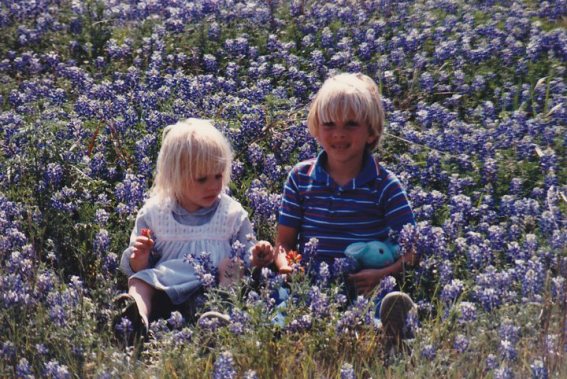
The writer and his sister in a field of Blue Bonnets near Barton Creek Square Mall, on the edge of the Texas Hill Country

My blogging friend Nick Bromley is skilled at taking handfuls of memories from his childhood and writing about the connections he makes between his quests in adult life and the early events that made him who he is.

Nick’s post is less of an essay than it is a poignant, unfinished reflection on those moments frozen in the past that resonate as significant years later.  In the Essays on Childhood project, we strive to encourage the writing process in various stages.  Nick is an accomplished writer, but he also knows the value of allowing the smaller visions and insights to gain a life of their own in a few paragraphs.  I’ve been reading his blog long enough now to know that it’s these times when he allows himself to make concrete even the vaguest memories that lead to real breakthroughs later.

Every writer could take a tip from Nick in this department.

You may read his entire post here, The Geography of Identity; Where Blue Bonnets Paint the Hills « Atoms of Thought.

“Everything outside of the picture still exists.  The four lane highway carries more cars today than when I was a boy, but it looks exactly as it did almost three decades ago.  The mall has changed very little on the outside.  A few apartments have risen on nearby hills with glorious views of downtown Austin and the thunderstorms that roll in from the east every Spring.  Everything in the picture, however, has disappeared.  The hill remains, of course, but Lady Byrd Johnson and her army of Blue Bonnet enthusiasts stopped seeding that hill soon after my sister and I posed on it for my parents.  It wouldn’t surprise me to learn that, in the interest of public safety, the city itself forbade parking on the shoulder of the highway to take pictures.”

Essays on Childhood: In a Man’s Voice

There are moments in life when someone casually helps you make a connection, and the effect is anything but small.  Such was the case when I grumbled to my friend Allan that I didn’t understand why it was so difficult to get a commitment from men to write for the Essays on Childhood project.

Allan said simply that it did not surprise him at all.  “Elizabeth, a lot of men find it very hard to write about their childhood.”  Something about the way he phrased that made me rethink the dynamic.  I realized I processed the hesitance to follow through as a lack of interest.  Allan helped me see it’s not that at all.  It’s a level of difficulty and often of pain that may be more pervasive in male childhood experience than female — not at all to say women have easy childhoods, but there is something here connected to the male psyche and experience in the early years that may be keeping a lid on what is actually a very keen interest in writing.

William Stafford

Allan is a writer, editor, teacher, and author published many times over.  His second book on the spiritual struggles of boys is due to roll off-press soon.  Obviously he was himself a boy once, but beyond that he has jumped into the deep end, both personally and professionally, of analyzing the male childhood experience.

Allan’s first book on the issues opens with this chilling poem by William Stafford:

Sure You Do

Remember the person you thought you were?  That summer

sleepwalking into your teens?  And your body ambushing

the self that skipped from school?  And you wandered into

this carnival where all the animals in the ark began

to pace and howl?   The swing they strapped you in?

The descent through air that came alive, till

the pause at the top?  The door on the way down

that opened on joy?  And then, and then, it was

a trap.  You would get used to it:  like the others

you could shoulder your way through the years, take on

what came and stare without flinching, but you knew at the time

it was goodby to everything else in your life.

The great door that opened on terror swung open.

The first time I read this poem I was unable to speak, literally, for a full 30 minutes.  I put it in front of a few men I know, and with limited commentary said, “I’d like to know what you think of this.”  The effect of the poem on my friends was similar to the effect on me, but with a key difference:  While my silence came from the shock of surprise, theirs was from the instant recognition of what was presumed to be a secret.

In 2012, Essays on Childhood will engage this challenge of creating a space and a process for men to write about their childhood experience.  One observation is that men tend to write with more personal distance from their subjects than do women, and when the subject is one’s own childhood that is not exactly an option.  I am fortunate to know a lot of very cool men — smart, funny, serious, engaged people who possess unique viewpoints and an interest in connecting with other people.  They may not know I identify them this way, but part of the next wave will be telling them and asking them to lead this grand experiment…………

Esse Diem readers, your suggestions for this outreach are more than welcome!

(Much gratitude goes out to John Warren, who was the first man to write for Essays on Childhood, to Michael Powelson who shared an essay from his own blog for EOC, and to Julian Martin, who will be representing the male voice in the essays shared before the end of the year.)

Image credit:  Poets.org