Our Mothers, Farewells, and The Departed

Ada was the biological mother of three of my friends, but it was not until she died  recently that I truly knew she was my mother, too.

I spent most of my late adolescence in her world.  I attended 4-H club meetings in her basement, shared overnights with her daughter, rode in her panel van to Jackson’s Mill and Camp Virgil Tate, ate in her kitchen, played ball in her front yard, ran up and down the basketball court at her church, and even hid out in her new basement bathroom the night before I was married.

Ada was synonymous with comfort and a place called home.

She had incredibly good posture.  I wish even in my tallest, straightest moments I could stand like she did.  Her crystal blue eyes always stayed connected to mine when we spoke; in fact, at her memorial service I shared my belief that talking to her was like being in a tractor beam, and the comment received rolls of laughter in recognition.  Apparently I was not the only  person upon whom she focused her full attention when talking and listening.

Trying to pin down her most memorable trait, for me it was this utter focus in conversation.  While that may not sound particularly special at first, consider how many people in your life you can say always — always — give you their full attention when you are together.  She had a husband who was significantly older than she was, and who needed her towards the end of his life as much if not more than her three children needed her in their own growing up, yet she never seemed lacking in energy and interest in others.

To see Ada was to feel joy.  I remember hundreds of times I saw her.  Sometimes it was unexpected, like in the grocery store.  Other times it was entirely anticipated as she opened the front door to her home and her face lit up as she exclaimed, “Liz!  Come on in, it’s so good to see you!”  Whether at her front door or in the bread aisle, her presence was consistent and loving.  She was what I think everyone dreams of, sometimes even subconsciously, when they dream of a mother.  She was one of her parents’ eleven children.  As a middle arrival, maybe that is where she learned the skill of managing younger and older people equally well.

This past weekend I drove up to her house for the first time since her death.  It was all routine until my car reached the first familiar bend in the road that for thirty years led me to the place Ada raised her family, extended and otherwise.  My chest felt oddly hollow and I took a moment to make sure my heart was still beating.  I took the next turn, and the car rose up the hill which would crest in the homestead I sought.  There was that strange chest sensation again as I reached the driveway and my eyes rested on the place where Ada no longer was and never would be again.

The house is empty, save for a few remaining personal things, their destination and ultimate dispensation to be determined by Ada’s children.  It is a strange place to me now, this domestic structure that for decades held some of the happiest times in my life.  I’m not sure what I expected, but I think it was to feel some of Ada still in the house.  The truth is, I didn’t feel her there at all.  I felt very sad, and I began to process and manage some of the larger grief I feel beyond the acute pain from the event of her death.

When a person and the home they built disappears in a physical sense, it is a heavy thing.  Forced to deal with this passing, I had clarity about Ada and all that she shared with me as an anchor in my own psychic landscape.  I remember a similar feeling when my beloved Uncle Guy died, a physical feeling of loss, like a gaping wound was echoing a cold wind on aching walls.  The deep desire to put my hands on my lost mother, to feel her and see her and hear her again, is still intense.

I know from losing my uncle that the ache will diminish but never fully go away.  When Ada died, one mysterious term kept popping into my head: “The departed.”  While I am not Catholic, I am familiar with the concept of the departed from the prayer that reads,

Eternal rest grant unto them, O Lord, and let perpetual light shine upon them.  May the souls of the faithful departed, through the mercy of God, rest in peace. Amen.

The spiritual concept of a soul having escaped the limits of what we know is, for me, spooky and compelling.  Something about a person’s essence having made an exit with a sense of other-worldly destination rings true in Ada’s unexpected and heartbreaking death.  She departed.  She is somewhere else now.  I can’t see this place, or touch her there or hear her voice, but I feel strongly she is in a new home, where she is greeted — always — with complete love and focus.

As we like to say in Christian parlance, “The tomb is empty.”  That is a metaphor, but it is also reality.  I love you, Mrs. K.  Thank you for everything.  You shaped my life, and I will never forget you.

Image credit: Mary Cassatt
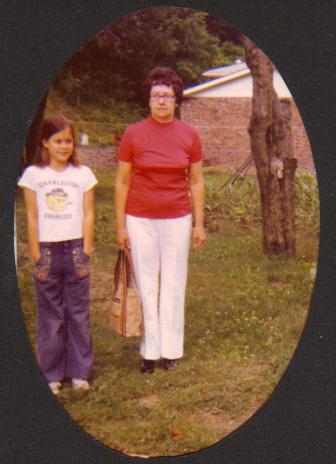
Growing Up (part 4) by Christi Davis Somerville

The writer and her Mamaw 1976

My relationship with Mamaw was one of the best things about growing up next door to my grandparents.  It’s difficult to think of her now, since her passing has only been just recently.  My heart aches when I think about her and I miss her more than I thought I would.  In many ways, I was like the daughter she never had.  Mamaw was my security blanket.  She was my homemade quilt, frayed around the edges, but always comforting.  In many ways she was a complex woman.  Highly private and somewhat socially awkward, she was the matriarch of our entire family.  Being the eldest of seven, her job of caretaker followed her throughout her years.  She was a supreme worrier, and was able to conjure up bad happenings better than anyone I ever knew.  But where Papaw was inconsistent, Mamaw was consistent.  Always.

Not only was Mamaw my neighbor, she was also my elementary school cook.  I was fortunate enough to be with her at school every day at Loundendale Elementary.  School was another extension of home and I felt like we owned the place.  I was privy to places (like the kitchen) that other students weren’t allowed to go.  If I started feeling poorly and was sent to the clinic, I had instant sympathy beside me to make me feel better.  (Except when I was faking sick, and she’d sternly look at me and tell me to go back to class!)  In Kindergarten, my entire class called her “Mamaw.”  This upset me so much that I didn’t want to say her name out loud at school.  She was my Mamaw and I certainly did not want to share her with a bunch of other kids!  As I got older, I realized that having her at school was sometimes good and sometimes bad.  Good on days when we had mashed potatoes (an extra helping for me) and bad when I occasionally got in trouble (guess who took me to the principal).

Mamaw was well-known throughout the family and the neighborhood for her homemade hot rolls and cinnamon rolls.  There was no recipe, just lots of hard work and love put into everything she prepared.  Many times I watched her work her magic by turning a little Hudson Cream Flour, eggs, sugar, yeast, and condensed milk into a small piece of dough and roll it around on the kitchen countertop and, ta-dah!, the most perfect little roll of dough you could ever imagine would magically appear.  Twenty four of those little dough balls would go into the oven and a few minutes later, a smell would waft down the hall that would make anyone’s mouth water.  When the bread was done, she’d take it out of the oven and my job was to brush each roll with melted butter.  I can still remember the sound of the butter when it would sizzle on top of those rolls.

There are so many things I learned from Mamaw that I don’t think I would have learned had I not spent so much time with her.  She taught me how to tie a quilt (it is really the ugliest quilt you’ve ever seen—polyester stripes and patterns, brown flannel backing—it is referred to now as the “Tacky Quilt” but I made it!).  She taught me how to make lye soap, and what a science experiment that was.  Lye soap could take the paint off of a Buick!  She tried, really tried, to teach me how to make her famous homemade bread.  I failed miserably since I didn’t understand how to “feel the dough” to know when it was right.

Mamaw taught me other things too.  She taught me to always be prepared.  Whatever the situation, Mamaw could pull whatever we needed, from a wet washcloth to a cough drop, out her huge purse.  She taught me to save my money, but to spend it too on important things—not trinkets or toys.  She taught me to be compassionate, especially for children who had less than I did.  She taught me to always put my family first.  She taught all of this by example, not in words.

My grandmother and I developed quite a close relationship over the years.  We would sit at the kitchen table and talk for hours about nothing in particular, sometimes talking about several different things at once.  Every spring we would go to the farmers market and buy entirely too many flowers—marigolds, pansies, and impatiens–and wonder where in the world we would plant them all.  In the spring, we would count down the winter days to welcome spring at Watt Powell Park to be the first in line on opening day for baseball season.  Sometimes the cold spring air coming out of South Park hollow would make our teeth chatter, but Mamaw would fix a thermos of strong hot tea for us to sip on so we could cheer the Charleston Charlies, and later the Wheelers, and finally the Alley Cats, to victory.  We would read books, Anne of Green Gables, A Tree Grows in Brooklyn, Heidi, and talk about our favorite parts.  Sometimes she would tell stories about growing up just around the hill on Mt. Alpha.  She would tell me stories of how she met my grandfather and how he called her “chicken legs” when he saw her walking down the road one day.  We spent a lot of time together and I wouldn’t have had that opportunity had she not lived so close to me.

I’m sure my childhood would have been wonderful without living next to my grandparents.  I had, and still have, the best parents anyone could ever have.  I have a funny brother who saves lives for a living (a fireman—of which I am so proud).  I had a wonderful home, pets, good schools, vacations at the beach and camping.  But I really can’t imagine my life without having grown up beside Mamaw and Papaw.

Last April I received an urgent phone call from my brother.  Mamaw was in the hospital.  I heard the words “fatal” and “aneurism” as his voiced cracked to tell me the news.  I dropped everything and drove as fast as I could to the hospital to see her.  She had been having a hard time remembering things and getting around, but the thought of her dying just would not register in my brain, even though she was ninety one years old.

When I got to the hospital, I went directly into her room and knew in my heart that she was dying.  As I sat there with her alone listening to the beeping and humming of the machines, I held her hand and told her it was going to be okay, even though I knew it wasn’t.  She never opened her eyes, but I had to believe she could hear me.  I thanked her for all she had done for me, for all she had given me, for being there whenever I needed her.  I talked to her about our special times together and the memories we had…and then I watched her take her last breath.

It sounds so strange to say, but I’m glad it was just the two of us together when she passed.  I’m humbled that I was there to hopefully give her peace in her final moments on earth.  It was the most difficult thing I’ve ever had to do, but I will never regret being there for her one last time.

As I continue my online research into my family’s past, I see my parents, my grandparents, and all my family in a different light.

I see them now as children running through the creeks and hills.

I see them as young adults falling in love and building a home.

I see them as parents and grandparents wanting the best for their children and grandchildren and all generations to come.

And I see myself…….

Making a good life for my future generations and passing on the best of my childhood memories to them.

(This concludes Growing Up by Christi Davis Somerville.  See Parts 1, 2, and 3 of Growing Up in the previous posts.)